Urgency of Coal Transition
Accelerating the retirement of coal-fired power plants is a critical decarbonisation lever.
- Asia accounts for 50% of global greenhouse gas emissions, of which a third is from coal-fired power plants.
- If these plants operate as planned, they will exhaust about two-thirds of the carbon budget that we have remaining to keep the rise in global temperatures from increasing to within 1.5 degree Celsius.
However, phasing out coal is particularly challenging for Asia in three ways.
- First, the scale: Coal accounts for nearly 60% of power generation in the region. Asia’s energy demand is projected to increase by two-and-a-half times by 2050, on the back of economic development, population growth, and urbanisation.
- Second, the downstream social impact: Coal economy is also a key source of employment, particularly among the developing nations. Based on IEA’s estimates, of the 8.4 million employed globally across the coal value chain, more than 80% of these individuals are in Asia.
- Third, the profile of Asia’s coal: Asia’s coal plants are young, less than 15 years old on average. This makes the economics of phasing out coal more challenging, especially as new coal plants continue to be built to keep pace with energy demand.
Transition Credits as a Complementary Financing Instrument
Notwithstanding existing efforts to finance the early retirement of CFPPs, the large and young fleet of CFPPs in Asia means that additional financing mechanisms are needed to improve the economic viability of such transactions and to crowd in significant private capital at scale.
In September 2023, MAS and McKinsey & Company jointly published a working paper setting out how high-integrity carbon credits (termed as “Transition Credits”), arising from the emissions reduced through retiring a CFPP early and replacing with cleaner energy sources, can be utilised as a complementary financing instrument to accelerate and scale the early retirement of CFPPs. The credits must be aligned with globally recognised standards such as the Core Carbon Principles (CCPs) set out by the Integrity Council of Voluntary Carbon Market (ICVCM) and other Article 6 integrity requirements, as mandated by the United Nations Framework Convention on Climate Change (UNFCCC). MAS will explore ways for transition credits to align with the CCPs, in consultation with the ICVCM.
Simplified cashflows from early retirement of illustrative CFPP in Indonesia by 5 years
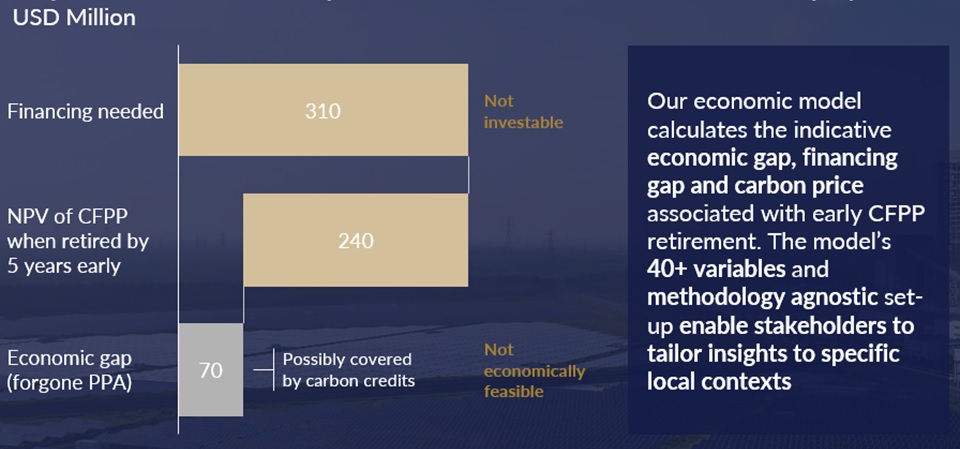
Source: MAS and McKinsey working paper economic model
A whole-of-system approach is needed to develop transition credits into a viable market solution. To further develop the approach and establish solutions for Transition Credits, MAS launched the Transition Credits Coalition (TRACTION) with the support of industry partners. MAS also collaborated with partners to test the feasibility of integrating transition credits for early CFPP retirement through pilot projects.
MAS' Initiatives
1. Transition Credits Coalition (TRACTION)
TRACTION, convened by MAS, comprises more than 30 members and knowledge partners across all key stakeholder groups from carbon credit services, energy financing, project development, risk management and non-governmental organisations.
With support from RMI as TRACTION Secretariat, TRACTION identified system-wide barriers and solutions for energy transition credits to be utilised as a credible financing instrument. These include robust crediting approaches that can be applied to regulated and deregulated electricity markets, mitigating risks of non-delivery of credits, and exploring avenues to build buyers’ confidence in transition credits. TRACTION focused on three areas of work:

Support high-integrity transition credits generation
Co-Leads: HSBC & Sylvera

Enable transition credits transaction scalability
Co-Leads: DBS & Howden

Bolster buyers’ confidence and trust in transition credits
Co-Leads: ACX & SCB
While TRACTION’s two-year mandate officially concluded at COP30 with the launch of its final report, its work will continue through broader public and private efforts led by industry leaders. The next phase will focus on translating TRACTION’s foundational work into scalable market activities with continued focus on integrity, transaction scalability and demand-building.
Given the complexity of Asia’s energy transition, this process will take time and require the development of more pilot projects in partnership with governments, financial institutions and development partners to build a robust pipeline of high-quality projects and realise the full potential of energy transition credits.
Given the complexity of Asia’s energy transition, this process will take time and require the development of more pilot projects in partnership with governments, financial institutions and development partners to build a robust pipeline of high-quality projects and realise the full potential of energy transition credits.
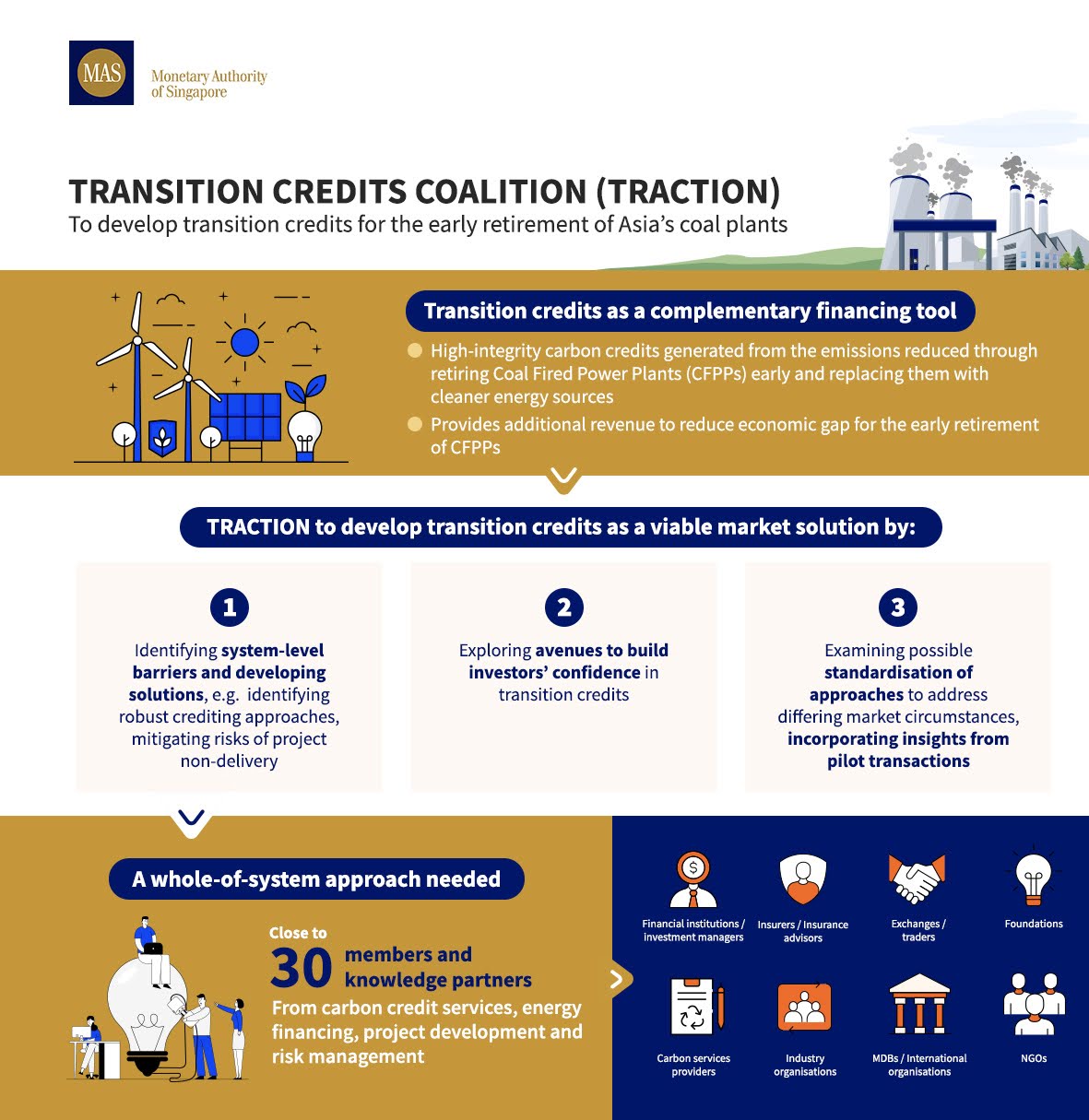
| Financial Institutions / Investors | |
| Bank of America Citi Clifford Capital Climate Smart Ventures DBS GenZero HSBC MUFG Mizuho Financial Group OCBC Sumitomo Mitsui Banking Corporation Standard Chartered Temasek United Overseas Bank Limited |
|
| Insurance Advisors | |
| Aon Howden Insurance Brokers |
|
| Exchanges / Traders | |
| AirCarbon Exchange Climate Impact X Vitol Asia |
|
| Foundations | |
| The Rockefeller Foundation |
|
| Carbon Service Providers | |
| Asia Carbon Institute BeZero Carbon Global Carbon Market Utility Gold Standard Sylvera |
|
| NGOs / Multilateral Development Banks / Industry Organisations / International Organisations / Others | |
|
Asian Development Bank McKinsey & Company World Bank Group World Wide Fund for Nature (WWF) Singapore |
2. Statement of Support for Energy Transition Credits
At COP30, MAS published a Statement of Support for Energy Transition Credits ("Statement") from private and public sector entities. This Statement demonstrates their interest to support the development and application of energy transition credits by participating in project transactions through offtake, financing or underwriting arrangements.
This collective expression of interest from corporates, financial institutions, multilateral development banks and sovereigns, provides plant owners and host governments with increased confidence to retire coal plants earlier than planned. It also serves to identify, convene and guide early movers in this space, fostering offtake readiness and encouraging broader participation from project developers, institutional investors, commercial lenders, ultimately driving ecosystem growth.
Download the Statement of Support for Energy Transition Credits (82.1 KB)
Pilot Projects
To explore and test the practicality of different approaches in integrating high-quality transition credits in the early retirement of CFPPs, MAS announced two pilot projects in collaboration with:
ACEN Corporation and Coal-to-Clean Credit Initiative, to accelerate the retirement of the South Luzon Thermal Energy Corporation coal plant in Philippines. Climate Smart Ventures, an advisory firm focused on energy transition, will be coordinating the project; and
Asian Development Bank (ADB), which is advising the Government of Philippines over the retirement of a coal plant in Mindanao under its Energy Transition Mechanism
While TRACTION members and partners will not be directly involved in any pilot transactions, insights from these pilots will contribute to TRACTION’s work in examining the possible standardisation of approaches that can be replicated across markets.
Watch the latest update from the pilot partners at FAST Conference 2024: From Commitment to Action: Accelerating Change through Transition Credits | Ecosperity Week 2024 (youtube.com )
Latest Updates
2025 COP30 Launch of Final Report and Statement of Support
- Opening Remarks by Mr Ravi Menon, Singapore's Ambassador for Climate Action, delivered on 10 Nov 2025 at the Launch of the COP30 Singapore Pavilion
- "From Pledges to Projects - The Role of Credible Financing Solutions-Capabilities-Capital" - Opening Remarks by Mr Chia Der Jiun, Managing Director, Monetary Authority of Singapore, delivered on 12 Nov 2025 at COP30 Singapore Pavilion Finance Day
- Final Report Presentation (1.6 MB) by Ms Abigail Ng, Chief Sustainability Officer, Monetary Authority of Singapore on 12 Nov 2025 at COP30 Singapore Pavilion Finance Day
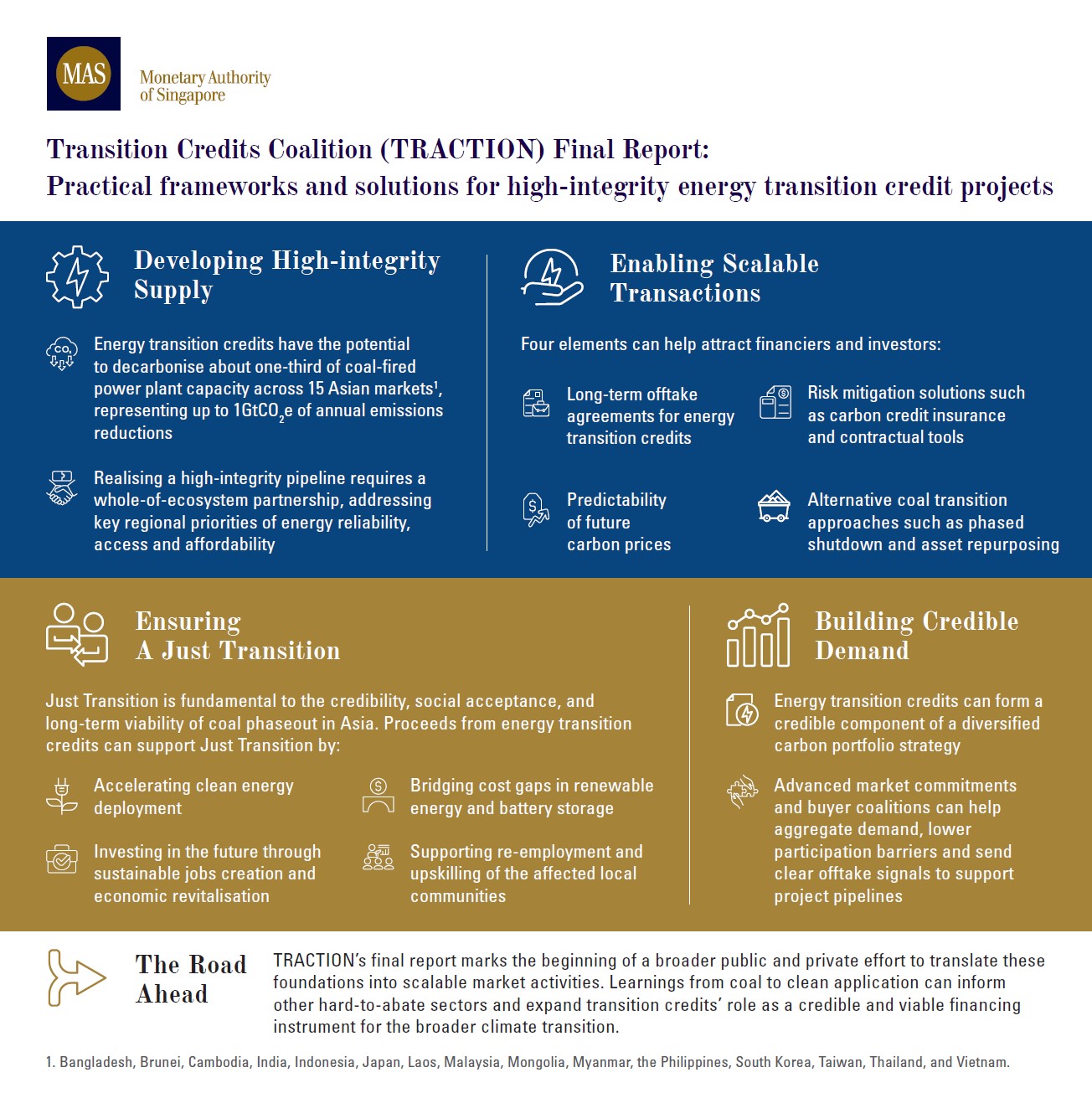
2024 COP29 Launch of Interim Report
- "Achieving Scale and Impact in Transition Finance" - Opening Remarks by Mr Leong Sing Cheong, Deputy Managing Director (Markets & Development), Monetary Authority of Singapore, delivered on 14 Nov 2024 at COP29 Singapore Pavilion Finance Day
- Interim Report Presentation (1.2 MB) by Ms Pamela Lee, Deputy Chief Sustainability Officer, Monetary Authority of Singapore on 14 Nov 2024 at COP29 Singapore Pavilion Finance Day
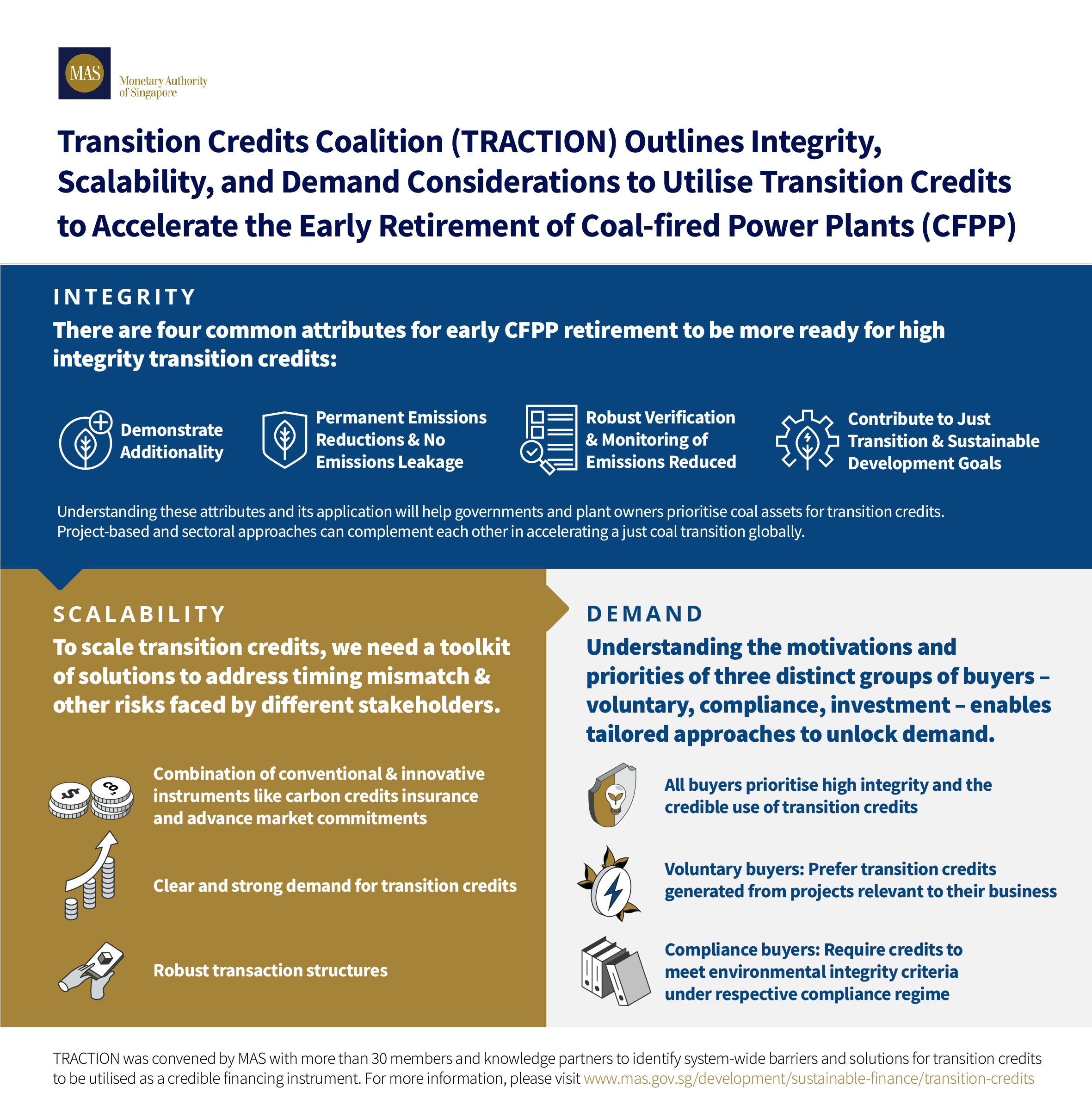
2024 New York Climate Week
- “Three Key Components of Market-Based Solutions – Ambition, Arsenal and Actors” - Opening Speech by Ms Gillian Tan, Assistant Managing Director (Development & International) and Chief Sustainability Officer, Monetary Authority of Singapore, delivered on 27 September
2024 at the World Bank – MAS Joint Event “Market-Based Approaches to Coal Transition”
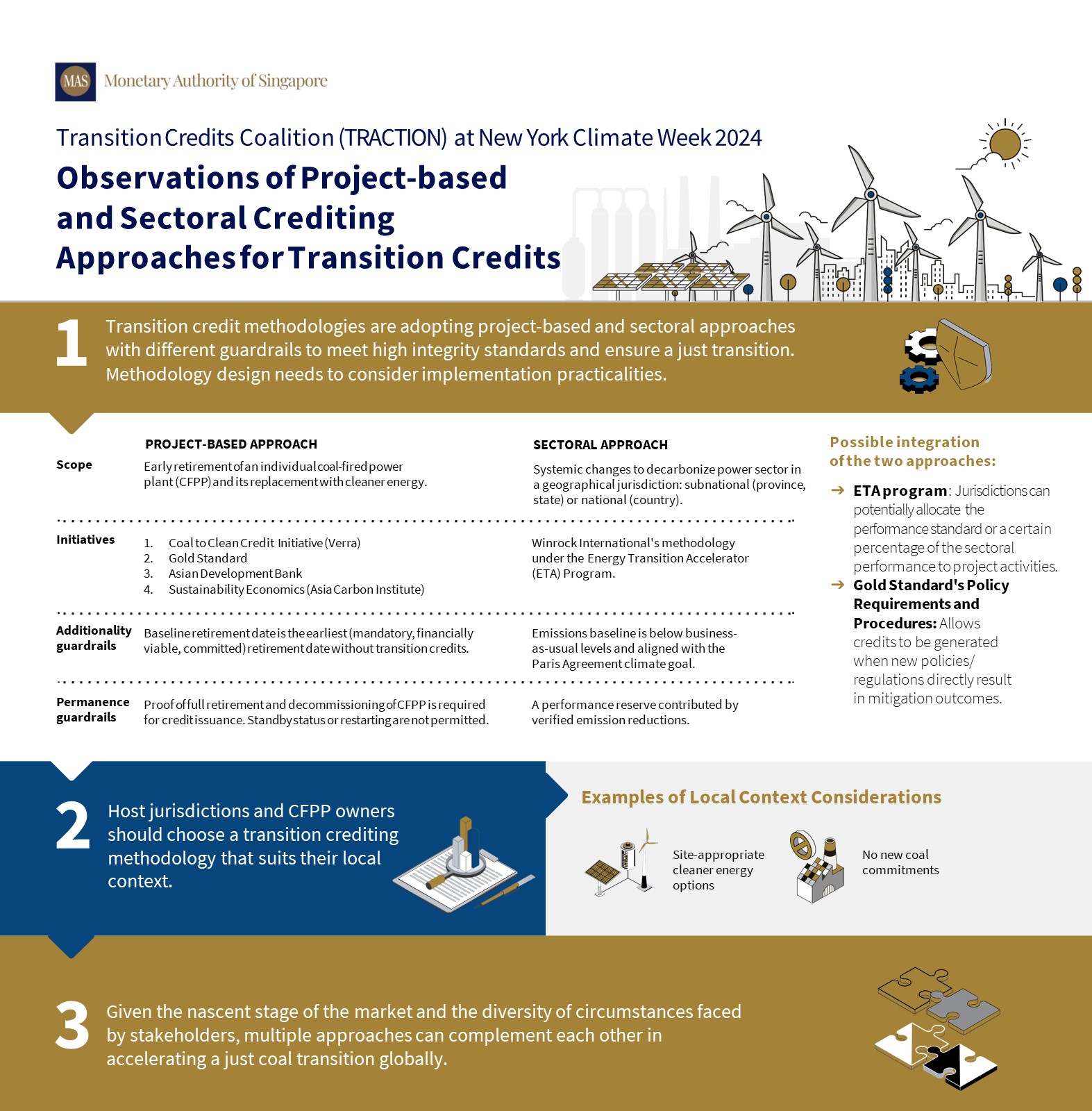
- Early Observations of Project-based and Sectoral Crediting Approaches for Transition Credits published on 27 September 2024
-
For more information, you may refer to presentation deck (370.4 KB).
-
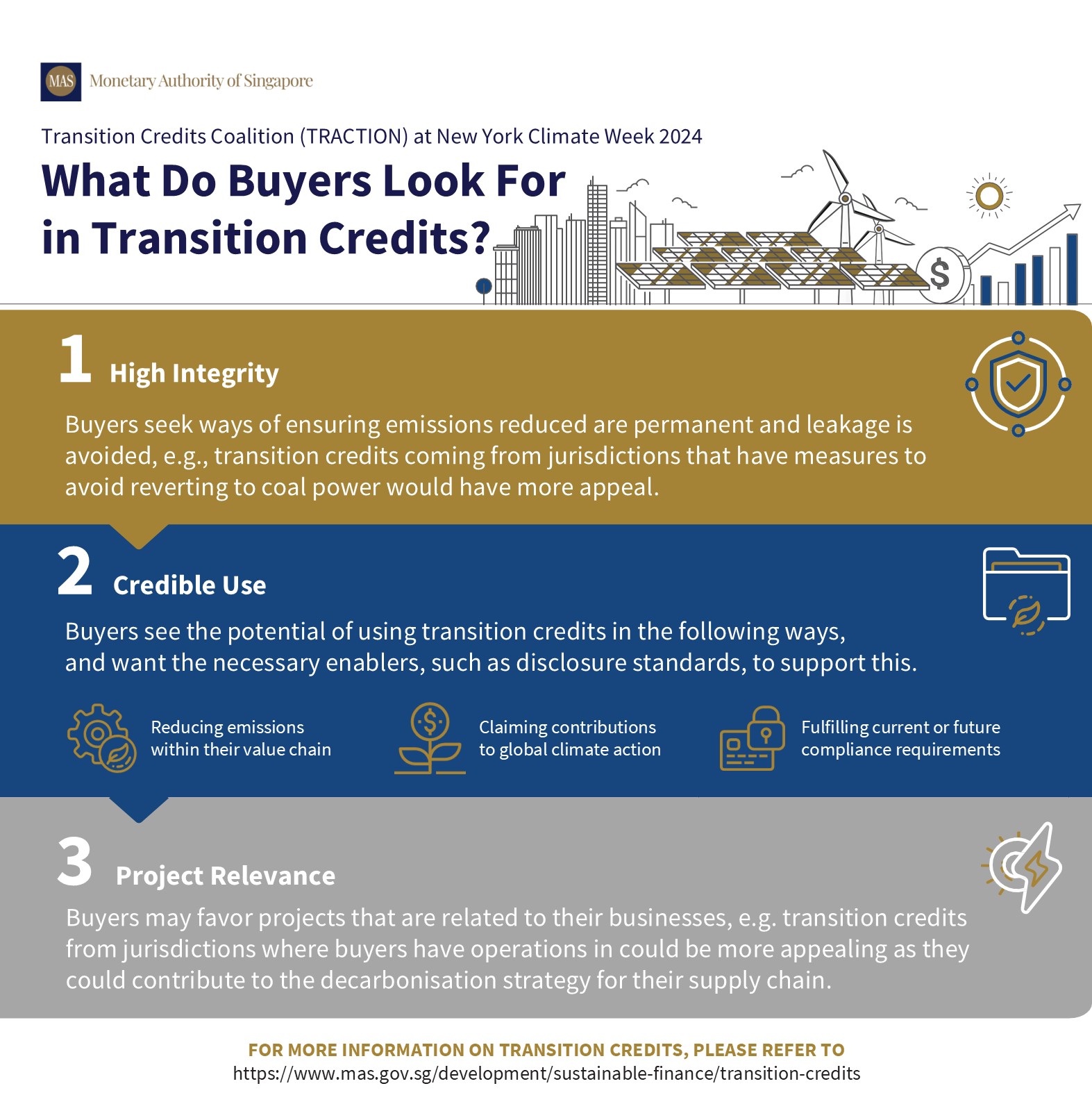
What Buyers Look For In Transition Credits published on 2 October 2024
2024 Financing Asia's Transition (FAST) Conference
-
“Financing Asia’s Transition – Bridging Global Ambition to Regional Action and Impact” - Opening Remarks by Mr Chia Der Jiun, Managing Director, Monetary Authority of Singapore, delivered on 17 April 2024 at the Financing Asia’s Transition (FAST) Conference.
- Update on progress of pilot projects: From Commitment to Action: Accelerating Change through Transition Credits | Ecosperity Week 2024 (youtube.com)
2023 COP28 Launch of Transition Credits Coalition (TRACTION) and Announcement of Pilot Projects
- "Getting Transition Finance Right" - Speech by Mr Ravi Menon, Managing Director, Monetary Authority of Singapore, delivered on 3 December 2023 at the COP28 Singapore Pavilion Finance Day
- MAS media release, published on 4 December 2023, on MAS Launches Coalition and Announces Pilots to Develop Transition Credits for the Early Retirement of Asia’s Coal Plants
2023 Launch of Transition Credits Working Paper
- "Harnessing the Potential of High-integrity Carbon Credits for Managed Phaseout of Coal" - Opening Remarks by Mr Leong Sing Chiong, Deputy Managing Director (Markets & Development), Monetary Authority of Singapore, delivered on 26 September 2023 at the MAS-McKinsey Working Paper Launch Event.
- MAS media release, published on 26 September 2023, on MAS and McKinsey Explore the Use of High-integrity Carbon Credits to Accelerate and Scale the Early Retirement of Asia’s Coal-fired Power Plants
- MAS and McKinsey Joint Working Paper, published on 26 September 2023, on Accelerating the Early Retirement of Coal-Fired Power Plants through Carbon Credits
Contact Information
Those with enquiries or have potential pilot projects to discuss are invited to write to transition_credits@mas.gov.sg .