Central Bank Operations
Monetary Management
- MAS’ monetary policy framework is centred on managing the Singapore Dollar against a trade-weighted basket of currencies. This is also known as the S$NEER.
- As part of MAS’ monetary operations, MAS manages:
- S$NEER through intervention operations (IO) in the spot foreign exchange (FX) market; and
- Singapore Dollar liquidity in the banking system through money market operations (MMO) and liquidity facilities.
- MAS may accumulate or expend Official Foreign Reserves (OFR) through its IO, by purchasing or selling Singapore dollars to manage the S$NEER.
- MAS also conducts MMO to maintain an appropriate amount of Singapore Dollar liquidity in the banking system, by injecting or withdrawing liquidity. The range of MMO instruments used include: (i) MAS Bills; (ii) direct borrowing or lending; (iii) repurchase agreements (repos) on Singapore Government Securities (SGS); and (iv) FX swaps.
- MAS incurs interest expense in its conduct of MMO as liquidity is typically withdrawn from the banking system. The interest cost incurred is a function of the amount of MMO carried out and the prevailing Singapore Dollar interest rates.
- The amount of MMO depends on a range of factors, including the amount of IO conducted, the net amount of public sector cashflows (including issuance and redemption of SGS and related securities), the growth of banks’ deposit liabilities, and banks’ demand for reserve balances with MAS.
- The level of Singapore Dollar interest rate depends on a different range of factors, such as global interest rates and how they are transmitted to Singapore Dollar interest rates through actual and expected movements in the Singapore Dollar FX rates.
- In FY2022/23, MAS incurred S$12.6 billion in interest expense in its conduct of MMO, part of which is offset by interest income from Reserves Management Government Securities (RMGS).
Reserves Management Government Securities
- As part of monetary policy implementation, MAS may accumulate OFR to levels in excess of the amount it requires for the conduct of monetary policy and support of financial stability.
- Under such circumstances, MAS may subscribe to RMGS to transfer OFR above what it requires, to the Government for longer-term management by GIC. This enables such foreign assets to be invested in longer-term, higher-yielding assets.
- Since the introduction of RMGS in 2022, MAS has transferred over S$200 billion to the Government for management by GIC.
- In FY2022/23, MAS received S$3.4 billion in interest income from its holdings of RMGS. RMGS interest income is a function of Singapore Dollar interest rates and the size of MAS’ RMGS holdings.
Currency Translation Effects
- As MAS’ financial results are reported in Singapore Dollars, currency movements of the Singapore Dollar vis-à-vis the foreign currencies in which the OFR are held will result in translation effects in MAS’ financial statements. Currency translation effects are thus a consequence of MAS’ conduct of exchange rate-based monetary policy. These currency translation effects have no impact on the international purchasing power of the OFR, or on MAS’ ability to conduct monetary policy and support financial stability.
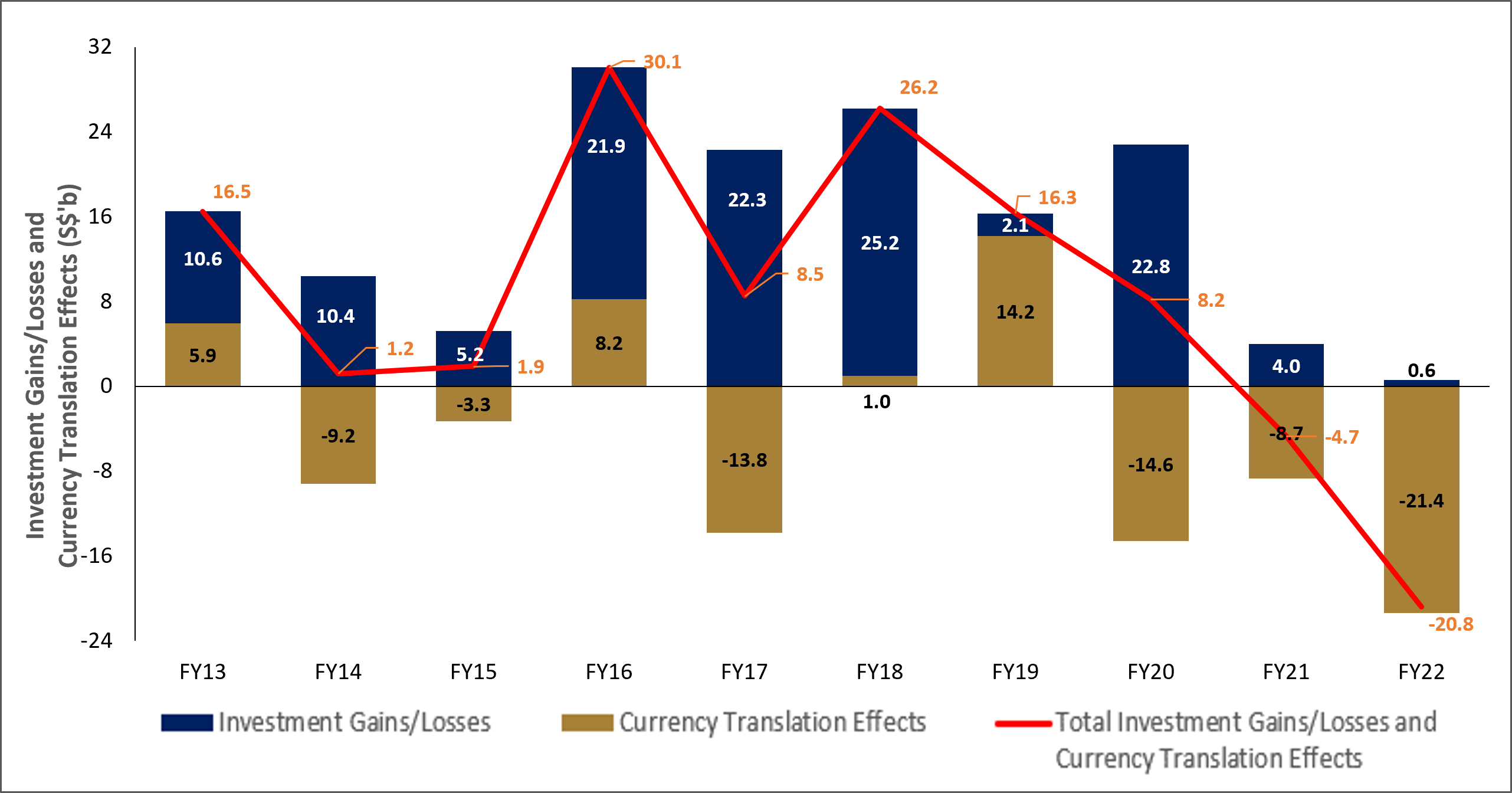
- In FY2022/23, currency translation effects were negative and amounted to S$21.4 billion as there was broad appreciation of the Singapore Dollar against the currencies that the OFR are held in (e.g. US Dollar, Euro, Japanese Yen and Pound Sterling).
- The currency translation effects(brown bars) over the past 10 years are shown in Chart 1.
Size and Composition of OFR
- MAS held S$416.0 billion (US$312.9 billion) of OFR as at 31 March 2023.
- MAS periodically assesses the optimal size of OFR that is necessary to implement monetary policy and support financial stability in Singapore. The optimal size of OFR is currently estimated at 65% to 75% of GDP. OFR in excess of the amount MAS considers necessary for the conduct of monetary policy and support of financial stability will be transferred to the Government through subscription of RMGS for longer-term management by GIC.
- The OFR is invested in a well-diversified portfolio of cash, bonds, equities and commodities that provides sufficient liquidity to implement monetary policy and support financial stability, and aims to provide good long-term sustainable returns while being resilient to risks across market conditions.
- The portfolio is also diversified across advanced and emerging market economies, and across different currencies.
- Investment-grade bonds in the advanced economies form the largest allocation in the portfolio. About three-quarters of the OFR are denominated in the US Dollar, Euro, Japanese Yen and Pound Sterling, with the bulk in US Dollar.
- The strategic allocation of the portfolio is reviewed periodically to ensure that the liquidity, risk and investment objectives continue to be met as market conditions change.
Investment Performance
- In FY2022/23, MAS recorded an investment gain of S$0.6 billion. Interest income, dividends and realised gains from the management of OFR were offset by valuation provisions in a year of aggressive rate hikes by central banks globally that resulted in negative valuation effects across all asset classes.
- The total investment gains/losses and currency translation effects, as represented by the dark red lines in Chart 1, was an overall loss of S$20.8 billion in FY2022/23.
- The investment gains/losses (blue bars) over the past 10 years are shown in Chart 1.
Chart 1: Investment Gains/Losses and Currency Translation Effects
Risk Management
- The MAS Board approves the investment universe and risk management framework.
- Investments are subject to risk limits and controls, and MAS conducts stress tests regularly to manage financial risks.
- MAS monitors investment risks closely and reports them regularly to the MAS Board and Risk Committee.
- As a conservative measure to ensure that MAS remains well-capitalised relative to its assets, MAS increased its issued and paid-up capital by S$25 billion to S$50 billion in the financial year ended 31 March 2023.
- Reserves Management Government Securities
- MAS media release, published on 7 April 2022, on MAS transferring S$75 billion excess OFR to the Government
- Second Reading speech by Deputy Prime Minister and Minister for Finance, and Deputy Chairman of the MAS, Mr Lawrence Wong, on the Monetary Authority of Singapore (Amendment) Bill, delivered in Parliament on 11 January 2022