Operational Resilience
The reliable delivery of financial services is essential to maintaining a trusted and resilient financial centre. Operational disruptions can occur due to external events like pandemics and natural disasters, or internal lapses like technology failures. The risk of such disruptions has risen given greater digitalisation, more reliance on third-party services, and increasing interconnectedness of the financial ecosystem.
2 Operational resilience refers to a financial institution's (FI's) ability to deliver critical business services and functions through disruptions. To achieve operational resilience, an FI will need to have effective frameworks on operational risk management, technology and cyber risk management, third-party risk management and business continuity management.
3 The four key pillars of operational resilience interact to ensure that FIs: (a) implement a robust governance structure and appropriate risk appetite; (b) similarly extend such oversight to external dependencies when third-party service providers are used; (c) manage cyber threats, system failures and digital transformation risks that could impact business operations or compromise third-party service providers; and (d) plan well for business continuity that include response and recovery measures which account for operational disruptions, third-party failures and technology incidents.
Diagram 1: Key Pillars of Operational Resilience
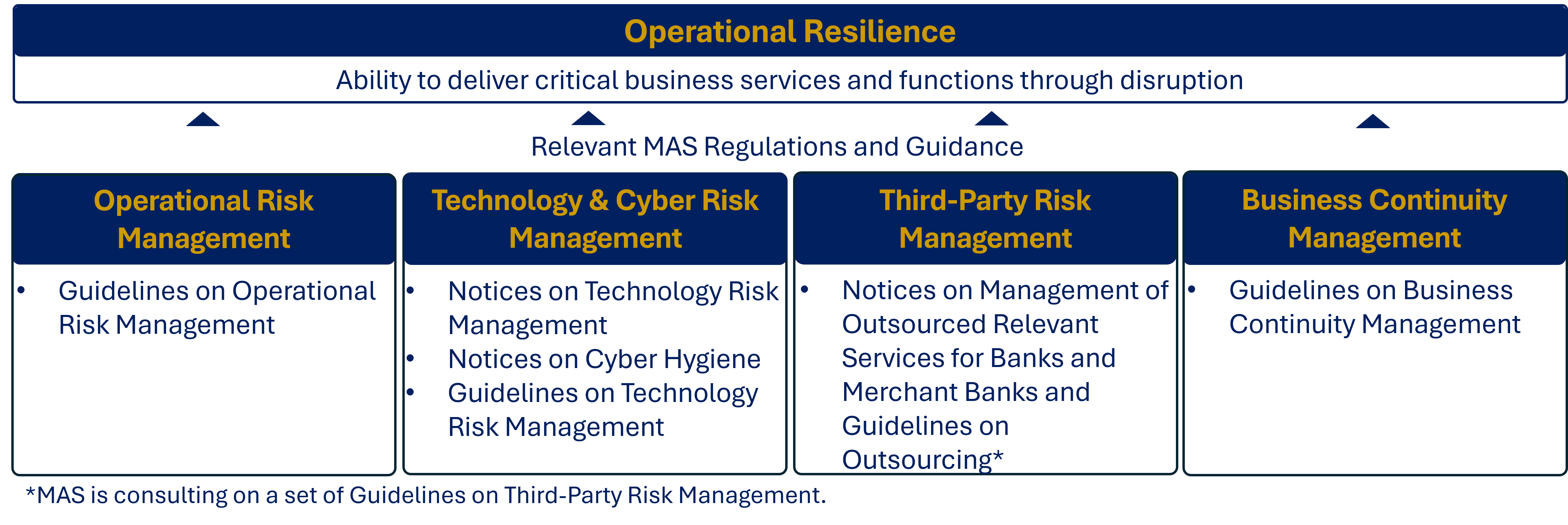
4 FIs should seek to minimise the occurrence of disruptions, and to minimise their impact if they occur despite best efforts. FIs should therefore have the ability to deliver critical business services and functions in the event of a disruption, albeit at a potentially degraded level. An operationally resilient FI should minimally be able to:
a) identify and prepare itself for both internal and external threats as well as potential operational risk-related events;
b) respond and recover from operational disruptions swiftly and safely to resume critical business services and functions within recovery time objectives; and
c) learn from potential operational risk-related events, operational disruptions, and near-misses with a view to enhance risk management practices.
5 MAS expects FIs to achieve a robust level of operational resilience. FIs should comply with MAS' regulatory instruments on operational risk management, technology & cyber risk management, third-party risk management, and business continuity management.
Operational Risk Management
Guidelines on Operational Risk Management:
Guidance for FIs to establish sound and robust operational risk governance and oversight. MAS consulted on the updated Guidelines on Operational Risk Management.
Technology & Cyber Risk Management
Notices on Cyber Hygiene:
Requirements that FIs have to comply with for the purposes of managing cyber hygiene on securing administrative accounts, applying security patching, establishing baseline security standards, deploying network security devices, implementing anti-malware measures and strengthening user authentication.
Notices on Technology Risk Management:
Requirements that FIs have to comply with, for a high level of reliability, availability and recoverability of critical IT systems and to implement IT controls to protect customer information from unauthorised access or disclosure.
Guidelines on Technology Risk Management
Guidance for FIs to establish sound and robust technology risk governance and oversight, as well as maintain IT and cyber resilience.
Third-Party Risk Management
Notices on Management of Outsourced Relevant Services for Banks and Merchant Banks and Guidelines on Outsourcing:
Requirements and guidance on managing risks associated with outsourced relevant services. MAS consulted on the Guidelines on Third-Party Risk Management. When finalised, it will provide guidance for FIs to implement controls commensurate with the nature and extent of risks arising from FIs’ use of third-party services regardless of whether the use of such services constitute an outsourcing arrangement.
Business Continuity Management
Guidelines on Business Continuity Management:
Guidance for FIs to take an end-to-end service-centric view in ensuring the continuous delivery of critical business services and functions to their customers.
What's New
-
Consultation Paper on Proposed Guidelines on Third-Party Risk Management
This consultation paper seeks feedback on the proposed Guidelines on Third-Party Risk Management which set out MAS' supervisory expectations of financial institutions’ use of third-party services.
- Consultation number:
- P004-2026
- Start date:
- 06 March 2026
- Closing date:
- 20 April 2026
-
Consultation Paper on Updated Guidelines on Operational Risk Management
This consultation sets out MAS’ proposed Updated Guidelines on Operational Risk Management. The Guidelines elaborate on MAS' supervisory expectations on effective operational risk management practices by financial institutions.
- Consultation number:
- P003-2026
- Start date:
- 06 March 2026
- Closing date:
- 20 April 2026
-
Consultation Paper on the New Omnibus Act for the Financial Sector
This consultation seeks views on the harmonised and expanded power to issue prohibition orders, the regulation of virtual asset service providers created in Singapore for anti-money laundering and countering of financing of terrorism purposes, the harmonised power to impose requirements on technology risk management, and the provision of statutory protection from liability to mediators, adjudicators and employees of an operator of an approved dispute resolution scheme.
- Consultation number:
- P002-2020
- Start date:
- 21 July 2020
- Closing date:
- 20 August 2020
- MAS response date:
- 14 February 2022