Risk Management
Managing physical and transition risks from climate change
Management of physical risks to MAS building
Physical risks could impact our buildings and property, for instance via flash floods or peak temperature. Physical risks can also impact companies which supply MAS with goods, services and raw materials, for instance, companies that supply our currency vendors with key raw materials used to produce currency notes.
Fortuitously, the MAS Building is located in a non-flood prone area. Several mitigating measures have been incorporated in the design of the building, including the placement of key critical equipment above ground level, having elevated building entrances, and implementing a water alert system in the basement carpark.
At the national level, PUB, our national water agency, has installed more than 300 water level sensors around Singapore for the monitoring of drainage systems, and has a SMS alert system in place, to facilitate timely updates to the public on potential flash floods.
Management of outsourced currency operations
MAS’ outsourced currency operations are exposed to both physical and transition risks arising from climate change. MAS has taken measures to mitigate and reduce the risks.
Physical risk arising from extreme weather conditions may result in production or delivery delays. MAS maintains sufficient stock to meet notes and coins demand.
Transition risk may cause a rise in cost for MAS’ outsourced currency operations. The open-tender procurement approach for currency replenishment allows us to award to a vendor that meets our requirements and provides the most value-for-money bid. As our vendor transits towards less polluting and greener operations, this may result in higher production and operation costs due to factors such as policy constraints on emissions in the vendor’s country of operation, higher carbon taxes imposed, and market changes. As such, it is important for us to lower our carbon footprint and progressively introduce measures to reduce public demand for new currency notes and coins.
Factoring climate-related considerations in procurement
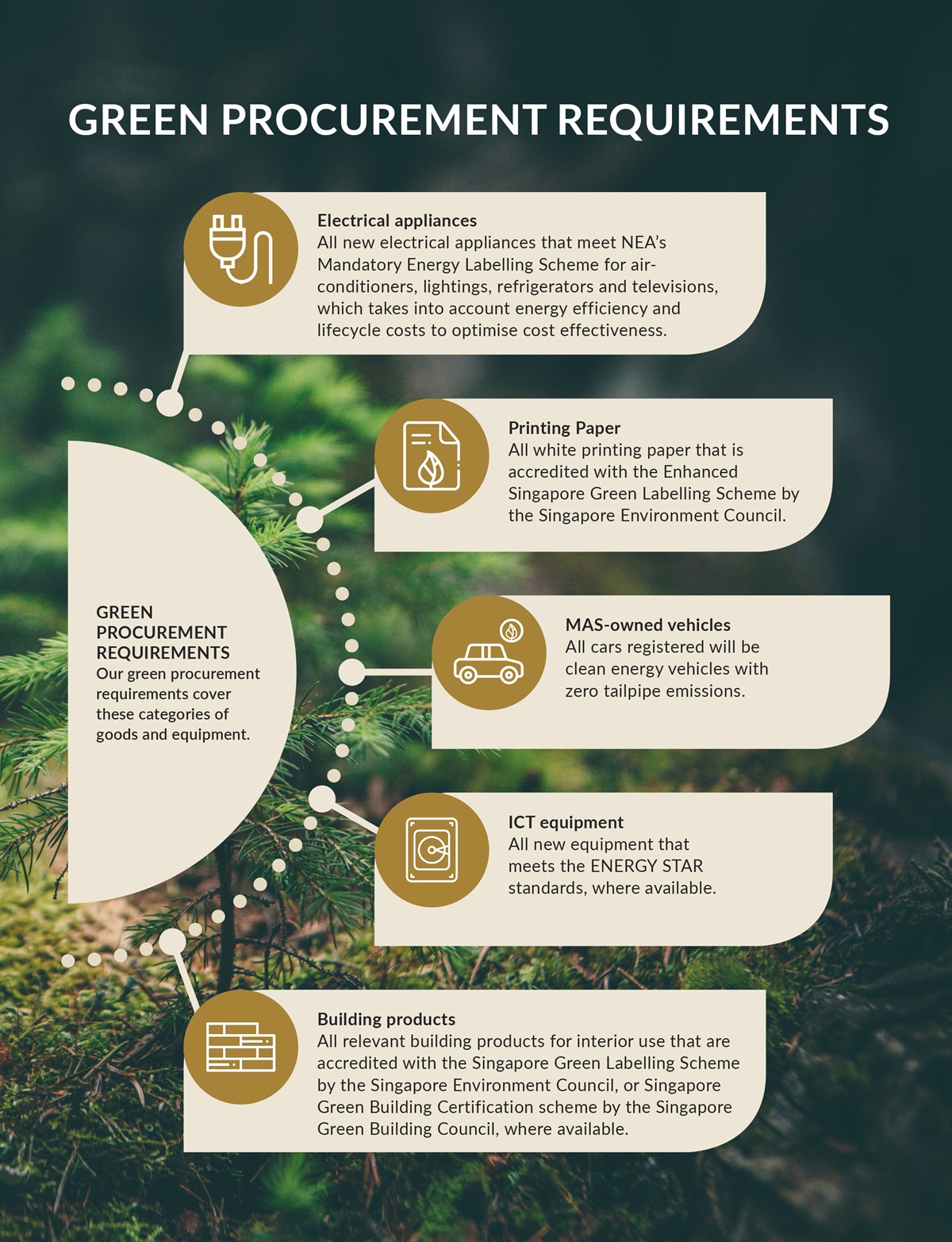
MAS has factored climate-related considerations in our procurement processes. We adopt the green procurement requirements from the GreenGov.SG framework and other initiatives such as National Environment Agency’s (NEA) Guaranteed Energy Savings Performance contracting model. This contracting model optimises the chilled water system design and ensures efficient performance, comprehensive maintenance, and guaranteed savings over a typical period of five years.
Our green procurement requirements cover the following categories of goods and equipment, as outlined below.