Strategy
Overview
Ecosystem development
Singapore accounts for close to 50% of cumulative ASEAN green and sustainability-linked bond and loan issuances. To enable companies to invest in sustainable projects and assets, and adopt sustainable business practices, MAS has introduced grant schemes to defray the costs of issuing green and sustainability-linked bonds and loans that meet international standards. MAS also partners the private sector and multilateral development banks to catalyse financing solutions for longer-term and marginally bankable sustainable projects.
MAS is keen to expand the sustainable finance ecosystem, covering financial institutions (FIs), ancillary service providers, academia, standard setting bodies and international organisations in Singapore. These stakeholders will catalyse the co-creation of innovative financing solutions, raise competencies, and enhance corporates’ adoption of sustainability practices. To mitigate risks of greenwashing, the Green Finance Industry Taskforce (GFIT), is developing a taxonomy that will define green and transition activities for Singapore-based FIs.
MAS is working with the public and private sector to support the development of a trusted and robust voluntary carbon market. Carbon markets provide a possible decarbonisation pathway for hard-to-abate sectors, alongside the development of decarbonisation technologies such as carbon capture, utilisation and storage.
Promote growth of sustainable finance solutions
MAS is catalysing the growth of sustainable finance solutions that enable companies to invest in sustainable projects and assets, and adopt sustainable business practices.
Grant schemes for sustainable finance solutions
MAS’ Sustainable Bond Grant Scheme (SBGS) was launched in 2017. The grant sought to support the issuance of green bonds in Singapore, by defraying the additional costs of verifying green, sustainability and sustainability-linked bonds as compared to conventional bonds while promoting the adoption of internally accepted standards. MAS’ Green and Sustainability-Linked Loan Grant Scheme (GSLS) was launched in November 2020 to encourage businesses to take up green and sustainability-linked loans. The grant defrays the expenses of engaging independent service providers to validate the green and sustainability credentials of the loan. The grant also encourages banks to develop green and sustainability-linked loan frameworks to make such financing more accessible to small and medium-sized enterprises (SMEs).
Notable bond issuances include:
- Surbana Jurong Group in Singapore issued Southeast Asia’s first SLB in February 2021, raising S$250 million. Its Sustainability Performance Targets (SPTs) are linked to a reduction in carbon emissions.
- Indonesia’s PT Japfa Comfeed issued a US$350 million SLB in March 2021, marking it as the first USD denominated SLB from Southeast Asia. Its SPT focuses on the construction of new water recycling facilities for sustainable water and wastewater management.
- China’s Yanlord Land issued a US$500 million green bond in May 2021. Proceeds from the issuance will be used to finance or refinance new or existing eligible green projects as described in the company’s green finance framework, including green buildings, enhancing energy efficiency, amongst others.
- In June 2021, Bayfront Infrastructure Management’s second issuance of infrastructure asset backed securities included a US$120 million sustainability tranche. Proceeds from this tranche are used to finance or refinance sustainable infrastructure projects. The sustainability tranche achieved a greenium of 5bps over its regular tranche, reflecting strong investor demand for high quality sustainability offerings.
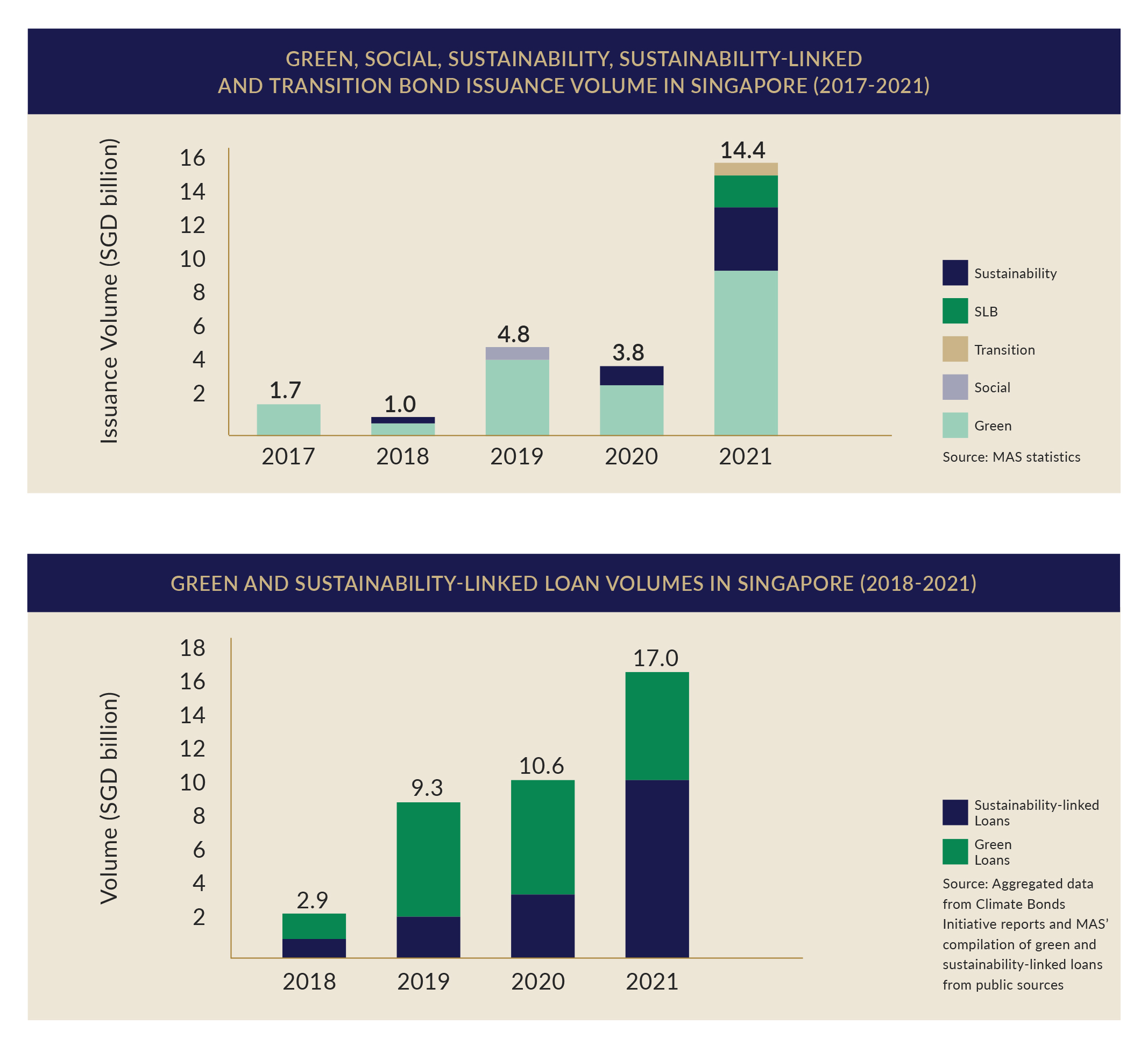
From 2018 to 2021, over S$39.8 billion of green and sustainability-linked loans have been issued in Singapore. In particular, sustainability-linked loans experienced exponential growth as volumes quadrupled since 2019. This reflected growing market acceptance for sustainability-linked loans, and the flexibility in use-of-proceeds as compared to green loans makes it applicable to a wider range of sectors.
Notable loan issuances include:
- The S$1.95 billion green loan by M+S Pte Ltd, which was the largest green loan secured by a real estate company in Asia Pacific. The proceeds of the loan will be used to partially refinance the office and retail components of Marina One.
- PSA Marine obtained a EUR30 million sustainability-linked loan, the first in Singapore’s maritime industry. The loan features an interest rate adjustment linked to ESG targets, which include requiring a fleet of PSA Marine’s Crew Transfer Vessels to be substantially deployed to support offshore wind energy-related activities.
- The US$374 million sustainability-linked loan by Hafnia Pte Ltd arranged by a syndicate of ten banks. The facility has an annual sustainability margin adjustment mechanism that depends on Hafnia’s continuous improvements in emissions-related key performance indicators (KPIs). It is one of the largest of its kind in the shipping sector.
- Sunseap Group obtained a S$85.8 million green loan for its SolarNova 4 project to instal solar photovoltaic (PV) systems across more than 1,200 public housing blocks and 49 government sites in Singapore. This represents the largest clean energy project in Singapore to date.
Develop voluntary carbon markets
Asia’s priority, as is Singapore’s, must be to reduce carbon emissions through abatement efforts. However, it may be challenging for some sectors, such as steel and utilities, to significantly reduce emissions in the short to medium term. A robust and high-quality carbon market is an important mechanism to channel funds to emissions reduction and removal projects for a more sustainable world.
The Singapore Government is keen to facilitate the growth of the carbon services ecosystem, by encouraging existing carbon services players and new entrants to expand their capabilities and use Singapore as a regional gateway for carbon services. Singapore houses a vibrant ecosystem of key carbon services players, with Trafigura, Mercuria and Pavilion Energy expanding carbon trading desks here. Singapore is also home to carbon exchanges such as AirCarbon Exchange and Climate Impact X (CIX) which are poised to become major players in scaling the voluntary carbon market regionally and globally.
CIX was established in Singapore in end-2021, and MAS has supported the development of CIX since its inception. In October 2021, CIX piloted an auction of a portfolio of eight high-quality, nature-based carbon credits projects, and the pilot auction cleared 170,000 carbon credits and was supported by 19 buyers from across various industries including Boston Consulting Group, City Developments Limited, Mercuria Energy, and Trafigura. In March 2022, CIX launched Project Marketplace and announced a partnership with Carbonplace, a new carbon credit settlement platform. Project Marketplace enables businesses and carbon project suppliers to list, compare, buy, and retire carbon credits. The digital platform will offer robust information on projects, along with third-party ratings and satellite monitoring technology to create greater trust in the voluntary carbon markets.
Grow sustainable finance expertise
MAS has been working with FIs and sustainable finance providers to expand the sustainable finance ecosystem in Singapore. In addition to Deutsche Bank, which set up an ESG Centre of Excellence in May 2021, and Moody’s Corporation which is deepening its suite of ESG resources, several FIs have also announced the establishment or expansion of their APAC ESG hubs in Singapore. These include Schroders and abrdn. Global firms such as McKinsey & Company and PwC also announced the respective launches of their Asia Sustainability Innovation Hub and Asia Pacific Centre of Sustainability Excellence in Singapore.
To establish Singapore as a regional knowledge hub for sustainable finance, MAS is anchoring centres of excellence, think tanks and research networks, and deepening sustainable finance skills and capabilities. This will deepen and expand Asia-focused climate research and training, and develop a strong pipeline of local sustainable finance talents.
Centres of Excellence (CoEs)
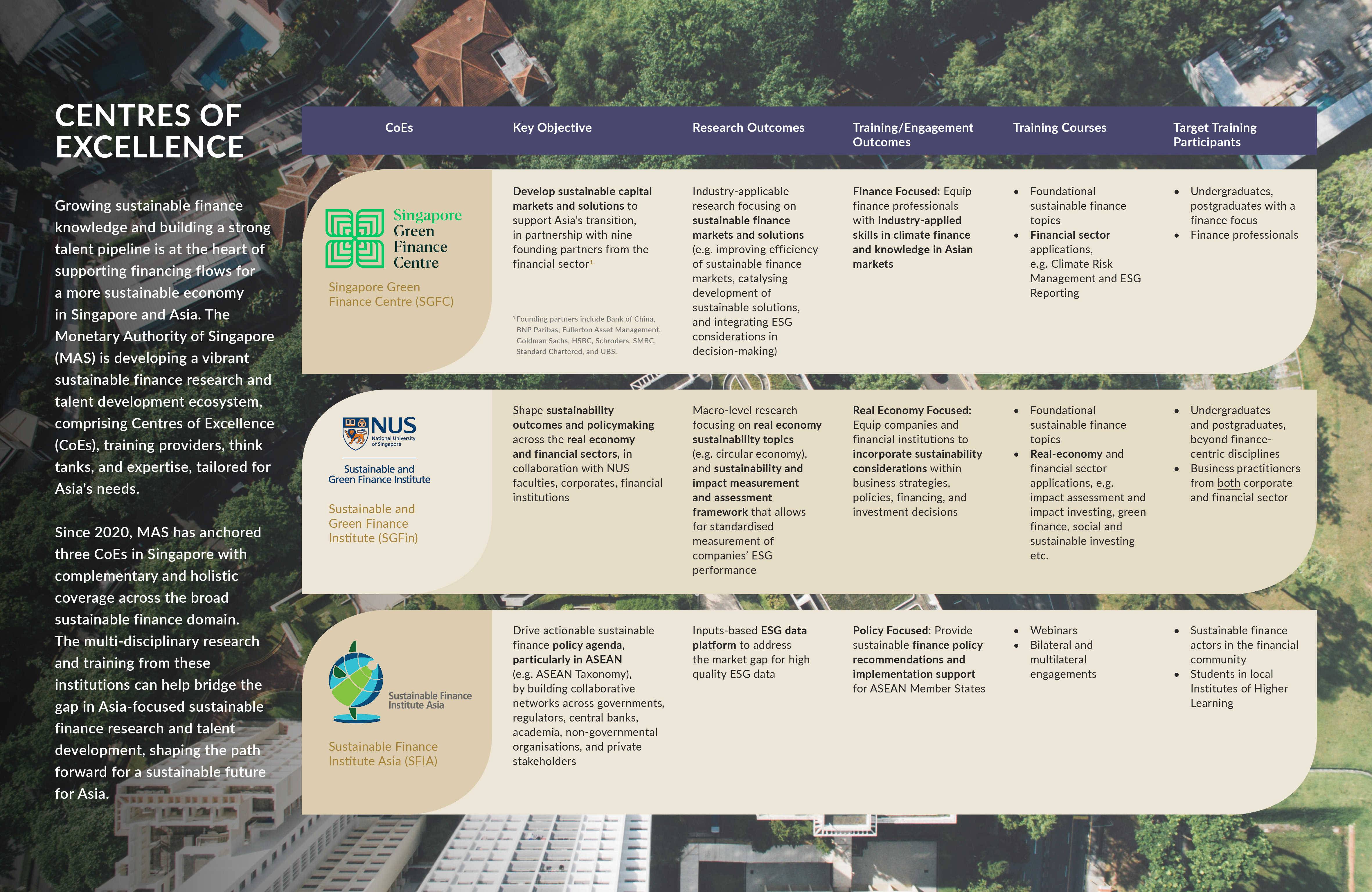
MAS has anchored three CoEs in Singapore – (i) Singapore Green Finance Centre (SGFC); (ii) Sustainable Finance Institute of Asia (SFIA); and (iii) Sustainable and Green Finance Centre (SGFin). The three CoEs have set out distinct value propositions, with the respective research areas complementing each other:
- Singapore Green Finance Centre (SGFC) is Singapore’s first centre of excellence dedicated to green finance research and talent development. It was launched in October 2020 by Imperial College Business School and Singapore Management University’s Lee Kong Chian School of Business, supported by MAS and nine founding industry partners. SGFC’s research includes regional climate risk modelling and impact assessment and measurement. In March 2022, SGFC held their inaugural Climate Academy for executives and key representatives from decision making functions across capital markets origination, risk management and asset management based in Singapore or across Asia Pacific.
- Sustainable Finance Institute Asia (SFIA) aims to catalyse and support the implementation of sustainable finance policy ideas in Asia, beginning with ASEAN, through advocacy and engagement activities. SFIA is the host of the ASEAN Taxonomy Board, which is developing a multi-tiered ASEAN Taxonomy for Sustainable Finance that will identify economic activities that are sustainable and help direct investment and funding towards a sustainable ASEAN.
- Sustainable and Green Finance Institute (SGFin), announced in September 2021, is hosted by the NUS Business School and collaborates with other faculties within NUS to produce multi-disciplinary research and training targeted at shaping sustainability outcomes and policy-making across the corporate and financial sectors. SGFin will be developing a sustainability impact measurement and assessment framework for corporates in Singapore and Asia, which aims to capture and translate granular ESG and impact data to determine the monetary value of companies’ environmental and social performance.
Download Centres of Excellence Infographic
Industry efforts to build capacity in sustainable finance
GFIT has launched a series of workshops and e-learning modules from May 2021 to April 2022 for FIs and corporates. These programmes aim to strengthen the capabilities within the ecosystem in areas such as environmental risk management, environment-related disclosures, and sustainable finance instruments to enable financial institutions and corporates to customise sustainable financing solutions for transition sectors. Since the launch, these capacity building workshops have been well-received by the industry players.
Sustainable Finance Skills and Training Roadmap
In February 2022, MAS and IBF launched the Sustainable Finance Technical Skills and Competencies (TSCs) under the IBF's Skills Framework for Financial Services. The new TSCs set out a robust, common level of sustainable finance proficiency, knowledge and abilities needed for individuals to perform various roles in sustainable finance. The TSCs will also serve as a reference for training providers and FIs to design and calibrate training programmes and for employers to refer to when hiring new recruits. Banks, asset managers and insurers have the flexibility to adopt SF TSCs relevant to their employees and organisation. The SF TSCs will be reviewed periodically to take account of evolving developments and needs in sustainable finance.
Making reference to the TSCs, the Wealth Management Institute (WMI), Investment Management Association of Singapore (IMAS), and the Association of Banks in Singapore (ABS) have introduced a series of capacity building workshops and initiatives.
- WMI is expanding its ESG programmes, taking reference from the MAS-IBF Sustainable Finance Technical Skills and Competencies. In March 2022, WMI launched an Applied ESG Investment and Advisory certification programme for family office professionals and advisors, and has plans to roll-out additional ESG programmes for asset managers, private bankers, next generation family principals and other stakeholders in the financial ecosystem in the coming months.
- IMAS has organised e-learning courses on their online portal iLearn and workshops on sustainable investing, environmental risk management, disclosures, and impact investing. In March 2022, IMAS held a full-day hybrid conference themed “Stewarding Capital Towards New Horizons: Investing for a Greener Future” to foster greater industry awareness on best practices in ESG and discussing topics such as the importance of integrating ESG into investment processes, what ESG would mean in Asia, and blended finance.
- ABS introduced a set of courses this year targeted at upskilling professionals in the financial sector, to facilitate the implementation of the Environmental Risk Management Guidelines that were introduced in December 2020.
Anchoring sustainable finance teams and organisations
- On 8 June 2022, the Glasgow Financial Alliance for Net Zero (GFANZ) announced the formation of its Asia Pacific (APAC) Network and the establishment of the GFANZ APAC Network Central Office in Singapore. GFANZ is supported by a permanent professional secretariat with expanded global representation and reach to facilitate ongoing and increased collaboration across the global climate community. MAS Managing Director will chair the GFANZ APAC Network’s Advisory Board. The APAC Network will serve as the coordination bridge between GFANZ and sub-sector alliances' work and financial ecosystems in APAC, and anchor technical climate transition related discussions, knowledge, research, capacity building and related initiatives.
Harness technology to enable trusted and efficient sustainable finance flows
Project Greenprint is a collection of initiatives which seeks to harness technology and create a data-centric ecosystem to support the financial sector’s sustainability agenda. The three key strategic focus areas for Project Greenprint are to (i) establish robust data infrastructure that will facilitate sustainability data flows between real economy and financial sector; (ii) develop a vibrant sustainability FinTech ecosystem through ecosystem development efforts; and (iii) promote innovation through partnerships and collaboration. These will foster a vibrant ESG FinTech ecosystem, and position Singapore as a launchpad for ESG FinTech solutions.
To develop a robust data infrastructure that will facilitate sustainability data flows between the real economy and the financial sector, MAS is working with industry partners to develop four interoperable data platforms. The data platforms will collect and aggregate ESG data across multiple sectoral platforms and industry players, and avail it for use by the financial sector.
- ESG Disclosure Portal - Facilitates consistent, comparable and reliable sustainability disclosures in line with internationally recognised reporting frameworks and enables external stakeholders’ access to these data by consent.
- Data Orchestrator - Aggregates ESG data from multiple data sources - major ESG data providers, utilities providers, ESG Disclosure Portal, and other sectoral platforms, and provides consent-based access to these sources. The platform will enable new data insights to be generated through data analytics to better support investment and financing decisions.
- ESG Registry - Records and maintains the provenance of ESG certifications and ESG data verified by certification bodies in different sectors, and facilitates trusted data flows between the financial sector and the real economy.
- Greenprint Marketplace - Connects green technology providers to investors, FIs and corporates, to facilitate partnerships and investments.
Greenprint ESG Disclosure Portal
The ESG Disclosure Portal seeks to be an integrated disclosure portal where reporting companies can upload corporate-level sustainability data in a structured and efficient manner and enable accessibility of sustainability data to multiple external stakeholders.
The portal seeks to (i) streamline structured and quality sustainability disclosures by corporates; (ii) promote transparency by enabling access to structured corporate-level sustainability data; and (iii) enable efficiency. To enhance efficiency, the ESG Disclosure Portal will address corporates’ current pain points where corporates report in varied systems, templates and formats. The integrated portal will be able to map data requirements across various standards and frameworks and facilitate the transfer of sustainability data to multiple external stakeholders. Data ownership belongs to the corporates and corporates will be able to give consent for authorised recipients to view and access their sustainability data, and these data will be presented in a structured format to allow for data consistency and comparability.
This project will start with a pilot with Singapore Exchange (SGX) for listed issuers in Singapore and SGX will be looking to onboard the first batch of listed issuers in 2022. Beyond the pilot, the portal will seek to also reflect other regulatory or voluntary disclosure requirements by other government agencies and private sector players based in Singapore.
Greenprint ESG Registry
The Greenprint ESG Registry, which is developed in partnership with Hashstacs Pte Ltd (STACS), aims to be a blockchain-powered data platform supporting a tamper-proof record of sustainability certifications and verified sustainability data across various sectors, providing FIs, corporates, and regulatory authorities a common access point for these data. This will facilitate better tracking and analysis of corporates’ sustainability commitments, impact measurement, alleviate greenwashing risks, and improve overall management of ESG financial products.
The Registry will be powered by STACS’ ESGpedia, which is currently deployed in its beta phase, with ongoing partnerships with numerous leading financial, non-governmental organisations and a growing ecosystem starting with the agri-food, building and construction, transport and logistics, carbon credit, and renewable energy sectors.
Facilitating FinTech partnership and innovation
MAS has earmarked S$50 million from the Financial Sector Technology and Innovation Grant Scheme (FSTI) to support Green FinTech projects in Singapore. The funding can be used to support proofs-of-concept, innovation labs, industry-wide utilities, and technology platforms focused on Green FinTech. As at March 2022, MAS is supporting eight Green FinTech projects through our FSTI Proof-of-Concept and Industry Wide funding schemes.
In November 2021, MAS and the Singapore FinTech Association (SFA) announced the award winners of the Global FinTech Hackcelerator, under the theme of “Harnessing Technology to Power Green Finance”. 283 participants in the Local Programme, supported by Oliver Wyman, addressed high-priority problem statements collated from FIs and green finance industry players in Singapore and globally. MAS will be working with the industry to develop an ESG Innovation Accelerator Programme, to catalyse and expand the Green FinTech eco-system.
In May 2022, MAS announced the launch of the 7th edition of the Global FinTech Hackcelerator, with the theme “Accelerating A Greener Digital Future”. The competition, powered by Oliver Wyman, seeks to leverage the potential of FinTech in accelerating the development of Web 3.0 and Green Finance in Singapore and the region. FinTech firms and solution providers around the world are invited to submit innovative solutions to address over 50 problem statements that have been collected from FIs and industry players. Under Green Finance, the problem statements focus on enhancing investor and financial institution’s ease of monitoring commitments and measuring impact of loans and investments against their sustainability goals. Examples of problem statements aimed at helping corporates and SMEs meet their sustainability goals include leveraging technology to create sustainable benchmarks in order to rate companies’ performance on a green scale.
To further expand the Green FinTech ecosystem, MAS will join the industry in launching a physical ESG Impact Hub - a co-working facility dedicated to the sustainability community and foster more collaboration and communication on cross-sectoral sustainability initiatives.
Collaborate with international partners
Collaboration with US, UK and Indonesia
The US and Singapore launched a climate partnership in August 2021 to strengthen collaboration between the US and Singapore on climate action, environmental governance, sustainable development and low-carbon solutions. Under the partnership, MAS will work closely with US counterparts on (i) advancing sustainable finance, including mobilising private capital for sustainable infrastructure; and (ii) enhancing climate and environmental risk management in the financial sector.
Indonesia and Singapore signed a bilateral Memorandum of Understanding (MoU) on Cooperation on Climate Change and Sustainability in March 2022. The cooperation was formalised following the Singapore-Indonesia Leader’s Retreat in January 2022 and will further strengthen engagement between Singapore and Indonesia on climate change and sustainability. Under the MoU, Singapore and Indonesia will collaborate on projects and initiatives for (i) carbon pricing and markets; (ii) nature-based solutions and ecosystem-based approach; (iii) clean technology and solutions; and (iv) green and blended finance. A key objective is to support decarbonisation in Indonesia, Singapore and the Southeast Asia region, by curating a list of low-carbon pilot projects and crowding in capital through blended finance mechanism. The success of these pilot projects would be used as a model to scale up or extend to other projects subsequently.
MAS and the UK Financial Partnership is supported by a MOU signed in June 2021. Under the Partnership, the UK and Singapore will explore opportunities for greater financial cooperation, including in green finance and carbon markets. Both countries reaffirmed the importance of interoperability of taxonomies to facilitate cross-border, sustainable financial flows and will work towards identifying compatibilities in the UK and Singapore taxonomy principles and metrics for green and transitional activities. Both countries also supported mandatory climate-related financial disclosures aligned with the Task Force on Climate-related Financial Disclosures (TCFD) recommendations, and will explore collaborating on a biodiversity pilot study, which will inform research into how nature-related risks will affect the financial system and contribute to this area of growing importance.