Overview
Efforts to combat climate change have accelerated and intensified since the Paris Agreement. 2021 was a landmark year, which saw an unprecedented number of countries and corporates pledging net-zero commitments in the lead up to COP26. Singapore has likewise ratcheted up our climate ambition, announcing in February 2022, our target to achieve net-zero emissions by or around mid-century.
Asia is key to the world’s transition to net-zero. The region accounts for about half of global carbon emissions, and more than half of global energy consumption. Asia must find ways to transition towards greater sustainability, while securing economic and social development for its people. Transition should be implemented in a just and orderly manner, even as net-zero commitments need to be backed by credible transition pathways.
Sustainable finance can be a powerful enabler for an effective yet inclusive transition to net-zero. Financial institutions (FIs) play an influential role in promoting sustainability and combating climate change, by directing capital to sustainable projects, as well as through active engagement to influence changes in their clients’ businesses. For marginally bankable but worthy green projects, or in areas where the size of funding is immense, public-private partnerships play an important role in de-risking and crowding in more private sector financing.
MAS is doing its part in the fight against climate change. MAS seeks to promote sustained non-inflationary economic growth, and a sound and progressive financial centre which supports and fosters financial inclusion. Environmental and climate considerations are integrated across MAS’ core functions:
- As a central bank and financial regulator, MAS works with FIs to strengthen the Singapore financial sector’s resilience to environmental risks.
- As a promoter of Singapore as an international financial centre, we work with FIs to develop a vibrant sustainable finance ecosystem to support Asia’s transition to a low-carbon future.
- As the guardian of Singapore’s official foreign reserves, MAS integrates climate risks and opportunities into our investment framework.
- As an organisation, MAS seeks to reduce its own carbon and environmental footprint to support Singapore’s broader climate ambitions and commitments.
MAS has been taking progressive steps to implement the Green Finance Action Plan (GFAP) introduced in 2019, to build resilience against climate and environmental risks and support a sustainable Singapore and facilitate Asia’s transition to a sustainable future. It complements the Singapore Green Plan 2030 and lays out MAS’ sustainable finance strategy across five thrusts (details in infographic). MAS works closely with other government agencies on climate change and sustainability, in particular on international Green Economy Agreements and other efforts to enable the growth of Singapore’s green economy.
Strengthening alignment of MAS’ Sustainability Report with the Task Force on Climate-Related Financial Disclosures (TCFD) guidelines
MAS published its first Sustainability Report in June 2021, detailing our efforts to strengthen the resilience of our financial sector to environmental risks, develop a vibrant sustainable finance ecosystem, build a climate-resilient investment portfolio, and incorporate sustainable practices in our organisation.
MAS advocates early implementation of sustainability reporting for the financial sector. Globally, there is a strong movement towards transparency and mandatory climate-related financial disclosures that provide consistent and useful information for market participants.
- G7 countries have, in June 2021, agreed to mandate climate-related financial reporting which are aligned with the TCFD recommendations.
- In November 2021, the International Financial Reporting Standards (IFRS) Foundation launched the International Sustainability Standards Board (ISSB) at COP26. MAS co-led a Technical Expert Group under the International Organization of Securities Commissions (IOSCO) Sustainable Finance Taskforce (STF), which reviewed two disclosure prototypes on climate and sustainability developed by the IFRS Foundation Technical Readiness Working Group. The ISSB’s work in developing a global baseline standard is important and timely, given the current proliferation of sustainability standards around the world.
Singapore has been actively promoting high-quality sustainability reporting domestically.
- Singapore Exchange (SGX) has unveiled its roadmap for issuers to provide climate-related disclosures based on the TCFD recommendations. The new listing rules require all SGX-listed entities to provide climate reporting on a ‘comply-or-explain’ basis from 2022. Climate reporting will be mandated in phases, with SGX-listed entities operating in industries identified by TCFD as most affected by climate change to be progressively subject to mandatory climate reporting from the financial year 2023.
- MAS is likewise setting out a roadmap for mandatory climate-related disclosures against a single, internationally aligned standard for our FIs. This builds on MAS' current supervisory expectations for all banks, insurers, and asset managers to make climate-related disclosures from June 2022, in accordance with well-regarded international reporting frameworks, such as the TCFD recommendations and/or future ISSB standards.
For the 2021/2022 MAS Sustainability Report, MAS has aligned the reporting of our sustainability efforts with the TCFD recommendations. This entails integrating TCFD’s four core pillars of governance, strategy, risk management, and metrics and targets within each of our four key themes – A Climate-Resilient Financial Sector, A Vibrant Sustainable Finance Ecosystem, A Sustainable Organisation, and A Climate-Resilient Investment Portfolio.
For A Sustainable Organisation and A Climate-Resilient Investment Portfolio, the disclosure of MAS’ physical operations and investment portfolio sustainability efforts references as relevant TCFD’s guide for asset owners and the Network for Greening the Financial System (NGFS)’ guide on climate-related disclosures for central banks.
- MAS aims to reduce emissions sizeably and achieve net-zero emissions at the earliest possible timeframe for our physical operations.
- The report outlines our strategy and efforts to mitigate the physical and transition risks arising from climate change on these core activities.
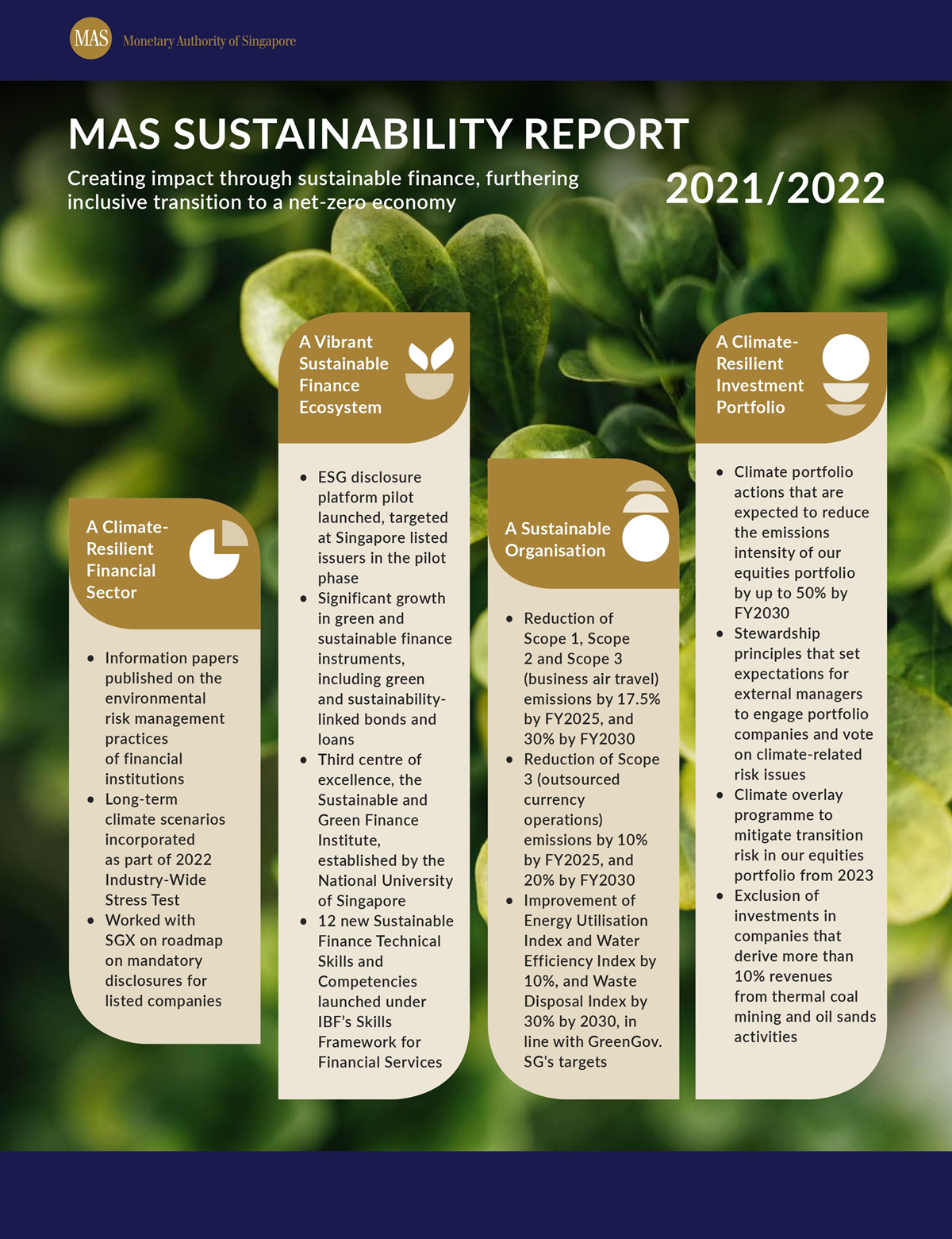
- Targets and new metrics have been introduced in this year’s Sustainability Report. This includes the setting of FY2025 and FY2030 targets for MAS’ Scope 1, Scope 2 and Scope 3 (business air travel and outsourced currency operations) emissions. For the reserves portfolio, we are implementing portfolio actions that are expected to reduce Weighted Average Carbon Intensity (WACI) for equities investments by up to 50% by FY2030. The WACI metric for corporate bonds will be reported for the first time this year.
The Sustainability Report also updates on MAS’ sustainability strategies in the areas of financial supervision and development of the financial sector. These include:
- Fostering a climate-resilient financial sector through strengthening the environmental risk management practices of FIs and disclosure efforts, as well as developing climate scenarios for scenario analysis and stress testing purposes; and
- Developing a vibrant sustainable finance ecosystem through accelerating the sustainable finance lending market, deepening sustainable research and capabilities and harnessing the power of FinTech.
Download MAS Key SR 2021/22 Highlights Infographic
Governance structure for climate change and sustainability matters
The Green Finance Steering Committee (GFSC), chaired by MAS’ Managing Director, is a monthly management forum within MAS that acts as the key decision-making body for all green finance and sustainability initiatives, and coordinates MAS’ green finance and sustainability efforts.
In October 2021, MAS set up the Sustainability Group, headed by a Chief Sustainability Officer, to coordinate MAS’ green finance and sustainability agenda, and serve as the secretariat to the GFSC. The Sustainability Group steers the sustainability efforts across MAS, makes sense of emerging sustainability trends, and supports the organisation in deepening capabilities in this multi-faceted area. As the pace of sustainability efforts accelerates in both the public and private sectors, regionally and globally, the Group also actively engages the broader sustainable finance ecosystem to advance key sustainable financing initiatives.
MAS actively seeks industry’s views on our sustainability initiatives. This includes tapping on MAS committees such as the International Advisory Panel (IAP), comprising leaders of global financial institutions, and the Financial Centre Advisory Panel (FCAP), comprising leaders from the banking, insurance and asset management industries in Singapore. Both panels advise MAS on Singapore’s financial sector strategies, including those related to sustainability.