Monetary Policy Statements
MAS Monetary Policy Statement - October 2026
For a quick overview of the monetary policy decision, read the Monetary Policy Statement at a Glance.
14 October 2026
INTRODUCTION
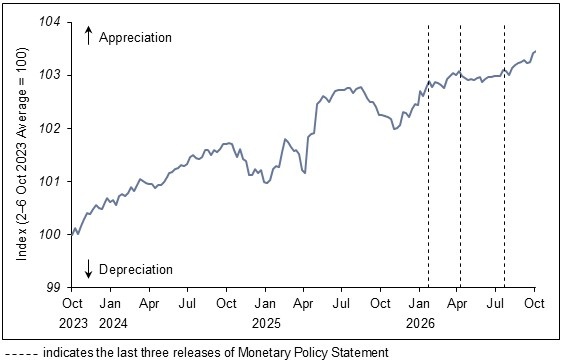
1. In its July 2026 monetary policy review, MAS increased the rate of appreciation of the Singapore dollar nominal effective exchange rate (S$NEER) policy band very slightly, with no change to the width of the band or the level at which it was centred. Since then, the S$NEER has strengthened modestly within the upper half of the appreciating policy band.
Chart 1
S$ Nominal Effective Exchange Rate
GROWTH BACKDROP
2. Economic activity in Singapore’s major trading partners has remained robust. AI-related investments globally are sustaining strong industrial production and trade, particularly in the region. The impact of higher energy costs on demand has, thus far, also been contained by the drawdown of existing inventories and supportive fiscal measures. While downside risks are present, global growth is projected to be resilient in the near term before gradually moderating over 2027. Global AI-driven growth is expected to ease in the latter half of next year from its current exceptional pace, while higher interest rates, amid elevated inflation in the advanced economies, would weigh on final demand growth.
3. According to the Ministry of Energy, Trade & Industry’s (METI) advance estimates, Singapore’s overall GDP grew by 5.4% year-on-year (y-o-y) in Q3 2026. Growth was led by robust expansions in the technology-related sectors of the economy. Most other sectors are assessed to have expanded broadly in line with their trend pace, with firm activity in the construction, financial services and real estate sectors, and some weakness in consumer-facing segments. On a quarter-on-quarter seasonally-adjusted basis, Singapore’s GDP growth came in at 1.1% in Q3 2026, a slightly slower pace compared to the preceding quarter.
4. The Singapore economy is expected to continue expanding steadily in the quarters ahead. Strong orders for AI products and an increase in production capacity should sustain firm growth in the technology-related sectors in the near term. The pace of AI-related activity is then projected to moderate in the latter half of 2027, even as the construction of major infrastructure projects as well as financial services activity continues apace. The economy’s positive output gap this year is forecast to narrow through next year. The government’s GDP growth forecasts for 2026 and 2027 will be announced in November by METI.
INFLATION OUTLOOK
5. MAS Core Inflation rose to 2.1% y-o-y in Jul–Aug, from 1.5% in Q2. Higher import costs passed through to a broader range of goods and services in line with expectations, with electricity & gas tariffs stepping up and inflation in fuel-intensive transportation services staying high. Food inflation also rose, to 2.2% from 1.9% over the same period, as accumulated cost increases were passed through to consumer prices. At the same time, services inflation came in lower than projected, tamped down by enhanced government subsidies for healthcare as well as more intense telecommunications services price competition.
6. Since September, energy commodity prices have risen anew and are projected to remain high in the near term. Global and regional food prices are also expected to pick up as costlier inputs and adverse weather patterns impact food production. Firming imported cost pressures in Singapore will keep core and CPI-All Items inflation at the current slightly elevated levels in the months ahead.
7. However, inflation is expected to moderate over 2027 as import costs ebb and domestic price pressures stay subdued. Supply disruptions to energy and food commodities should gradually ease. Unit labour cost increases in the services sectors are expected to be contained due to continued productivity gains. In addition, enhancements to government subsidies for healthcare and education will keep services inflation low over 2027.
8. All in, MAS Core Inflation should remain slightly elevated in the immediate quarters ahead, before easing more discernibly from mid-2027. For 2026 as a whole, MAS Core Inflation is forecast to average 1.5–2.0%, while CPI-All Items inflation should come in around 2.0%. Next year, both MAS Core Inflation and CPI-All Items inflation are projected to average 1.5–2.5%.
RISKS TO THE OUTLOOK
9. There continues to be significant uncertainty around the macroeconomic outlook. For now, the risks to inflation remain tilted to the upside. A sharp and sustained surge in global energy or food prices could lift Singapore’s import costs by more than forecast. Domestic inflation could also stay elevated if spillovers from the AI-related boom broaden and unit labour costs rise more rapidly. However, a higher-than-expected increase in interest rates or sharper pullback in AI-related investment could exert a drag on growth and thus inflation. Energy production and shipments from the Middle East could recover more quickly than projected, resulting in a greater decline in energy prices.
MONETARY POLICY
10. The Singapore economy should continue to expand at a firm pace in the immediate quarters ahead, and moderate thereafter as the AI cycle eases from its exceptional pace and global financial conditions tighten. Core inflation is projected to ease discernibly from the middle of next year, as supply-driven imported inflation slows and domestic costs stay subdued.
11. MAS will therefore maintain the rate of appreciation of the policy band. There will be no change to the width of the band and the level at which it is centred. The current appreciating policy band will allow the S$NEER to continue to strengthen and lean against the anticipated near-term rise in imported inflation, ensuring the gradual easing of inflationary pressures in 2027. MAS is well-positioned to respond effectively to any risk to medium-term price stability and will continue to closely monitor economic developments.
***
Related:
Latest Statements
-
MAS Monetary Policy Statement - October 2026
Read the Monetary Policy Statement for October 2026.
-
MAS Monetary Policy Statement - July 2026
Read the Monetary Policy Statement for July 2026.
-
MAS Monetary Policy Statement - April 2026
Read the Monetary Policy Statement for April 2026.