Price Stability
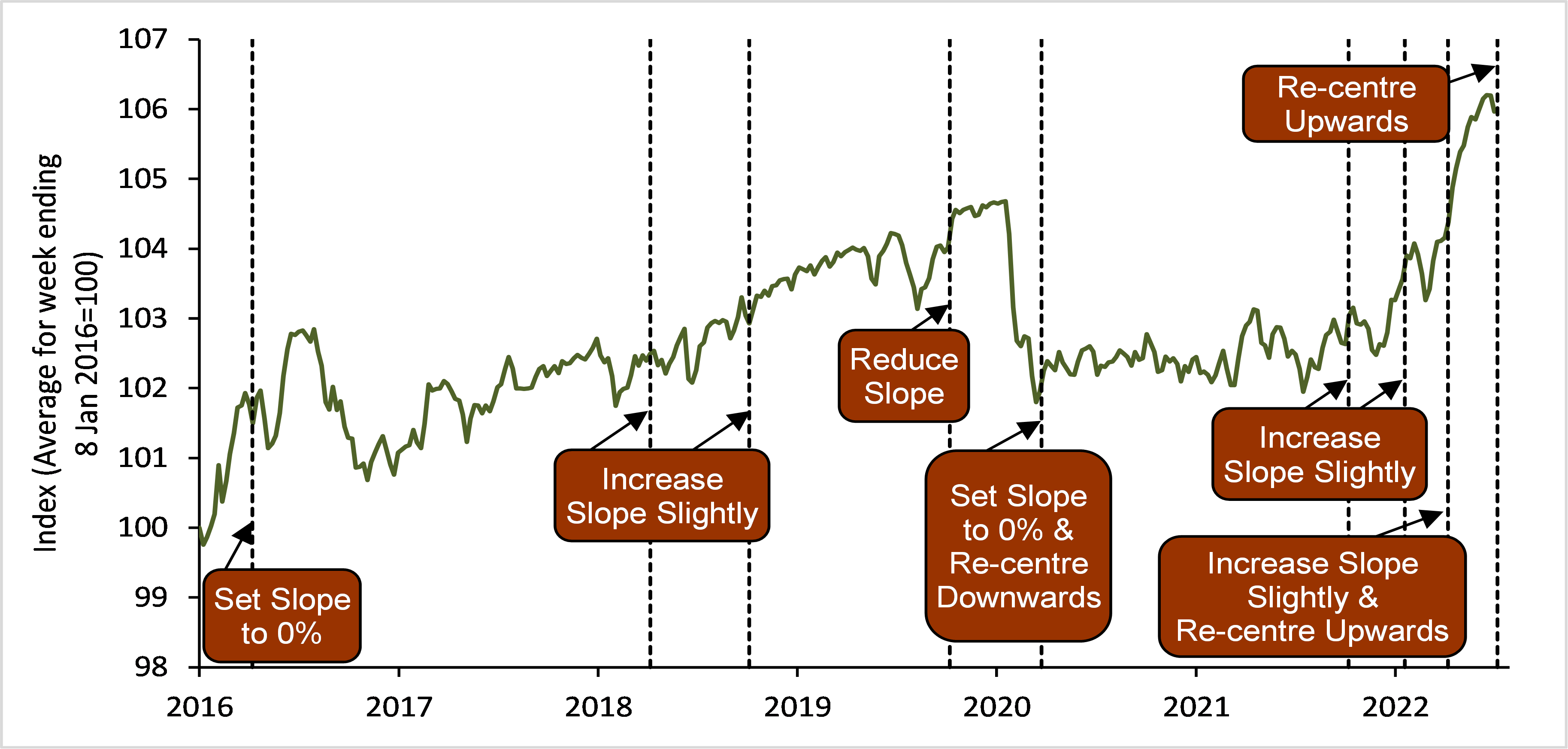
As the global economy emerged from the pandemic-induced recession, demand recovered strongly even as supply chain frictions persisted. External and domestic sources of inflation in the Singapore economy intensified. In October 2021, MAS began to withdraw monetary policy accommodation by adopting a slight positive slope in the S$NEER policy band. MAS subsequently increased the slope again in an off-cycle move in January 2022. In April 2022, MAS tightened monetary policy for the third time in six months, by re-centring the mid-point of the S$NEER policy band up to its prevailing level and increasing slightly the band’s rate of appreciation. In July 2022, MAS assessed that it was appropriate to further tighten its monetary policy stance to lean against price pressures becoming more persistent. MAS therefore re-centred the mid-point of the S$NEER policy band up to its prevailing level.
The Global Economy:
- A pickup in inflation has accompanied the rebound in spending and production activity in many economies since mid-2021. This has partly reflected supply bottlenecks and frictions. Tightening labour markets and rising core inflation in some economies suggest a broader inflationary process has taken hold.
- The outbreak of the Russia-Ukraine conflict in February 2022 added a further powerful impulse to inflation via steep increases in a range of commodity prices, reflecting the two countries’ important roles in the supply of these products. Global recovery is expected to continue at a more moderate pace in 2022 as the price shock squeezes real incomes, although elevated savings will provide some buffer to demand.
- Inflation is expected to ease in 2023 as major central banks withdraw policy accommodation and supply challenges are addressed. However, the outlook is subject to considerable uncertainty. A key risk is that the current upsurge in inflation could become embedded in price and wage settings, worsening the output sacrifice required to restore price stability. Additional strains on supply chains could cause further price shocks, increasing the risk of a de-anchoring of inflation expectations.
The Singapore Economy:
- The Singapore economy expanded strongly in Q4 2021, bringing its full-year growth to 7.6%. GDP in 2021 was underpinned by strong outturns in the trade-related and modern services sectors, even as activity in the domestic-oriented and travel-related sectors remained curbed by domestic mobility measures and border restrictions.
- Sectoral growth outcomes reversed in Q1 2022 and into Q2. External-oriented activities weakened amid the Russia-Ukraine conflict, while the domestic-oriented industries saw a broad-based expansion as Singapore took a major step towards reopening the economy further and treating COVID-19 as endemic from end-March. In the second half of this year, slowing growth in the global economy will weigh on Singapore’s trade-related sectors, even as the domestic-oriented and travel-related sectors continue to recover. For 2022 as a whole, Singapore’s GDP growth is likely to come in still above trend in the lower half of the 3–5% forecast range.
Inflation:
- In 2021, Singapore’s inflation picked up on the back of a recovery in domestic demand and stronger global inflation. MAS Core Inflation and CPI-All Items inflation rose to 0.9% and 2.3% respectively, following the mild deflation experienced in 2020.
- This year, strengthening cost-push and demand-pull pressures led to a broadening of price pressures in the Singapore economy, with MAS Core Inflation rising to 2.9% in the first five months of 2022. Business costs accumulated across a range of intermediate inputs including utilities, fuel, labour and imported goods. At the same time, domestic demand picked up significantly with the easing of COVID-related restrictions. In addition to the increase in core inflation, stronger private transport and accommodation inflation led to CPI-All Items inflation coming in higher at 5.0% in the first five months of the year.
- Overall inflationary pressures will remain elevated in the months ahead. Although global supply chain frictions are easing, external inflationary impulses have become more broad-based, reflecting underlying constraints in international commodity and labour markets. On the domestic front, wage pressures are likely to stay strong amid the tight labour market. For 2022 as a whole, MAS Core Inflation is projected to average 3–4% while CPI-All Items inflation is forecast to come in within 5–6%.
Chart 1: Singapore and Global Inflation (% Year-on-year)

Monetary Policy:
- MAS pre-emptively shifted to a positive rate of appreciation in October 2021 amid a steady pick-up in imported and domestic cost pressures. Global demand was forecast to expand firmly as economies adapted to operating with COVID-19. At the same time, inflation in many of Singapore’s major trading partners were rising due to pandemic-induced supply disruptions. In Singapore, notwithstanding lingering risks to the recovery, the economy was projected to expand at an above-trend pace. Labour market slack would decline, and the resident unemployment rate would fall further, supporting a recovery in wages. These factors would underpin a rise in core inflation.
- At the turn of the year, incoming data indicated that imported and domestic wage costs were accumulating more rapidly than anticipated, and that these were being passed through to consumer prices. The outlook for Singapore’s inflation had also shifted higher amid strongly recovering global demand and persistent supply-side frictions. Geopolitical risks posed further upside risks to inflation. Accordingly, in January 2022, MAS increased slightly the rate of appreciation of the S$NEER policy band in an off-cycle policy move.
- The outbreak of war between Russia and Ukraine in late February dented global growth prospects and caused fresh surges in commodity prices. Global inflation would see another step up, possibly for an extended period. Barring further severe stresses to the global economy, growth in the Singapore economy would slow but remain above trend, with the output gap still expected to be positive and the labour market tight. Core inflation would see a broad-based step up and come in higher than what MAS envisaged in January 2022. Underlying inflationary pressures also remain a risk over the medium term. MAS therefore tightened monetary policy for the third time in six months in April 2022, by re-centring the mid-point of the S$NEER policy band up to its prevailing level and increasing slightly the band’s rate of appreciation.
- Most recently, a further tightening of monetary policy was made in July 2022 by re-centering the S$NEER policy band up to its prevailing level. Even as headwinds to global economic growth were growing, on balance, it was appropriate to take a further calibrated step to tighten monetary policy given the risks of elevated inflation becoming entrenched. This policy move would build on the previous tightening moves to help slow the inflation momentum and ensure medium-term price stability.
Chart 2: S$NEER and Changes to the Monetary Policy Stance
- July 2022 Monetary Policy Statement
- April 2022 Monetary Policy Statement
- April 2022 Macroeconomic Review
- Senior Minister and Chairman of MAS Tharman Shanmugaratnam’s speech “Responding to a Perfect Long Storm”, delivered on 9 March 2022, at the IMAS-Bloomberg Investment Conference
- January 2022 Monetary Policy Statement
- October 2021 Monetary Policy Statement
- October 2021 Macroeconomic Review
- 50 Years of Inflation Experience in Singapore
- Managing Director of MAS Ravi Menon’s fireside chat “Global Economic Perspectives”, delivered on 31 August 2021, at the Financial Markets Association of Singapore Trampoline Charity Golf 2021