Reserve Management
MAS held S$513.8 billion (US$379.7 billion) of Official Foreign Reserves (OFR) as at 31 March 2022.
Size and Composition of OFR
- The OFR is invested in a well-diversified portfolio of cash, bonds and equities that ensures sufficient liquidity to support the conduct of monetary policy, and aims to provide good long-term sustainable returns, while being resilient across market conditions.
- The portfolio is also diversified across advanced and emerging market economies, and across different currencies.
- Investment-grade bonds in the advanced economies form the largest allocation in the portfolio. About three-quarters of the OFR are denominated in US Dollar, the Euro, Japanese Yen and Pound Sterling, with US Dollar forming the bulk.
- The strategic allocation of the portfolio is reviewed periodically to ensure that the liquidity and investment objectives continue to be met as market conditions change.
Investment Performance
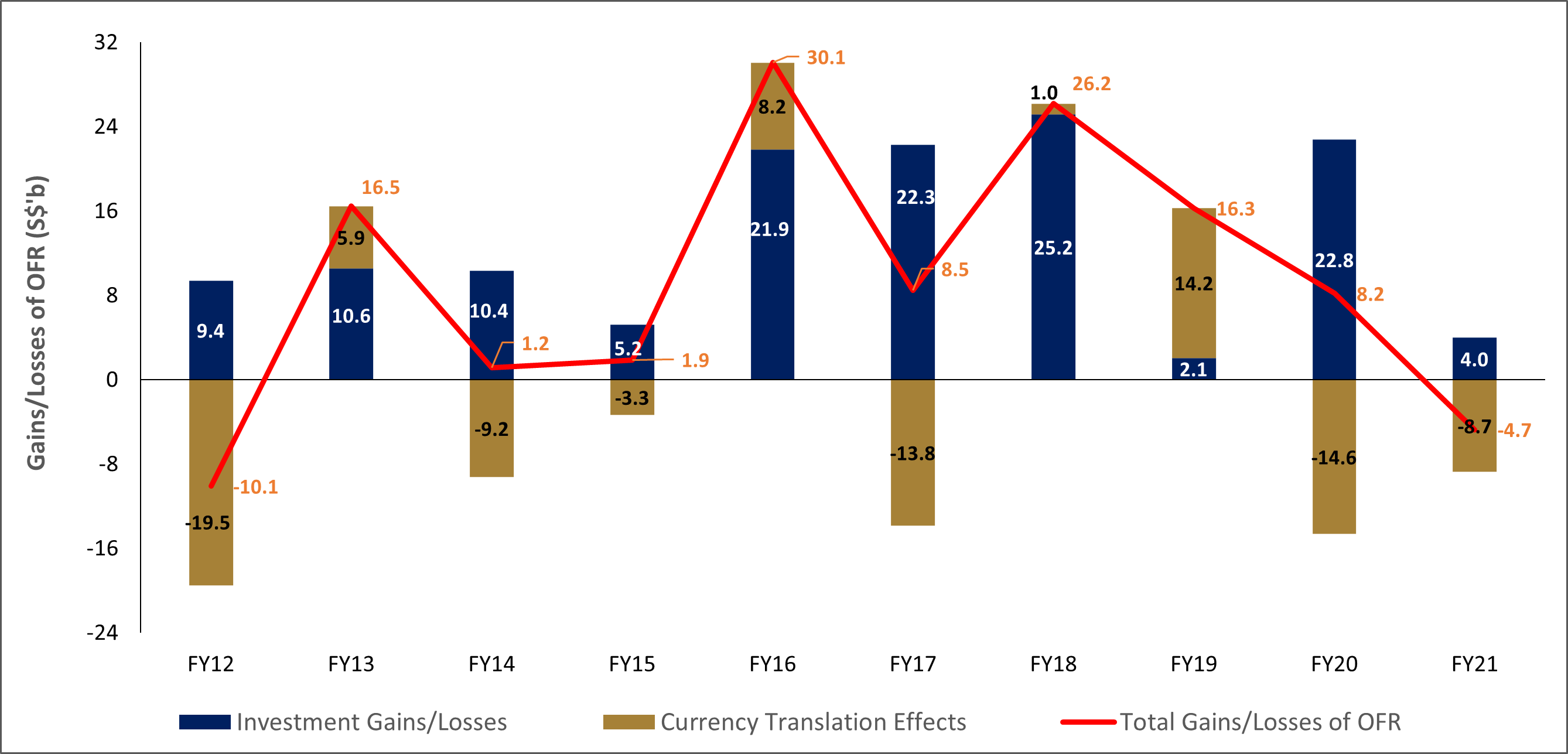
- The financial performance of the OFR over the past 10 years is shown in Chart 1.
- The overall gains/losses as represented by the dark red lines comprise investment gains/losses (blue bars) and currency translation effects (brown bars).
- In FY2021/22, MAS recorded an investment gain of S$4.0 billion, mainly from interest income, dividends and realised capital gains. Investment gains were recorded despite challenging market conditions and concerns over monetary tightening by global central banks to address higher inflation, as well as slower global growth and geopolitical tensions.
- Currency translation effects were negative and amounted to S$8.7 billion as the Singapore Dollar strengthened significantly against the Euro, Japanese Yen and Pound Sterling.
- Taking both into account, the OFR made an overall loss of S$4.7 billion.
Chart 1: Gains/Losses of OFR
Risk Management
- The MAS Board approves the investment universe and risk management framework.
- Investments are subject to risk limits and controls, and MAS conducts stress tests regularly to manage financial risks. Recent stress tests include COVID-19 related and stagflation stress scenarios.
- MAS monitors investment risks closely and reports them regularly to the MAS Board and Risk Committee.