Risks and Opportunities
Identify – transition and physical risks
Climate change can create financial risks for companies and investors through two main drivers:
Physical risks that result from more frequent and intense extreme weather events and changes in climactic condition
- First-order effects include the economic costs of physical infrastructure damage, operational stoppages, decreased production yields, and disruption to supply chains.
- Second-order effects include recovery and adaptation costs, reduction in land and labour productivity, with broad-based impact on economic growth and socio-economic development.
Transition risks that result from societal response to mitigate climate change.
- The level of risks is determined by the nature and magnitude of policy and regulatory responses, low emissions innovation, and end-user (corporate and household) behavioural changes that bring about a reduction in global emissions.
- The performance of companies in various sectors can be significantly impacted both positively and negatively. For example, higher carbon taxes can significantly impact earnings, raise the cost of capital, and reduce the availability of financing and risk underwriting for companies in carbon intensive sectors, while benefitting those involved in alternatives such as renewable energy and low carbon transportation.
Assess – focus on transition risks
MAS is focusing actions on transition risks in the Official Foreign Reserves (OFR)
Transition risks are more imminent compared to physical risks.
- Climate policies and actions to transit to a low carbon economy need to occur well before the most damaging physical effects of global warming materialise. For instance, to meet mid-century climate goals, the pace of transition would have to be aligned with a reduction of about half of global emissions by 2030 from 2019 levels.
- Results from the climate scenario analysis study conducted on the portfolio further showed that there is a wide dispersion of transition risk impact on economies, sectors and companies, depending on the pace of transition. The faster and more disruptive the transition, the wider the dispersion of impacts as it shortens the runway to navigate the switch away from a dependence on fossil fuels, adopt energy-efficient solutions and develop low-emissions technologies. More broadly, it increases the pressures on fiscal, corporate, and household balance sheets to manage the overall costs associated with a low-carbon transition.
- This suggests the need for early portfolio actions to protect the portfolio from downside risks arising from a faster-than-expected transition, and adopt strategies that can reap returns from the transition to a sustainable low-carbon economy.
- We will continue to study the effects of physical risks on our long-term investment returns, particularly in a Failed Transition scenario.
Manage – implement actions for equities portfolio
We are implementing actions at the total portfolio level for equities investments and through external fund managers
At the total portfolio level:
As an asset owner, MAS is responsible for the performance of the OFR, asset allocation decisions, and the level of risks that is appropriate to achieve a desired level of returns. Targeted portfolio actions to manage climate risks are tools that help us shape the portfolio characteristics that best serve our investment objectives.
Although the OFR has a larger allocation towards cash and sovereign bonds, it is the equity assets that contribute to most of the expected lowering of long-term returns arising from climate risks.
- Equities are more impacted compared to cash and bonds. Equity returns represent the discounted future earnings streams from owning a part of businesses and are therefore more sensitive to (i) changes in macro-economic factors (e.g. GDP) due to climate change; and (ii) changes in companies’ earnings caused by climate-related variables such as carbon prices, oil and gas demand and clean technology deployment.
- The impact on bonds is more muted as the overall higher credit quality of the portfolio, especially the credit quality of government bonds, is not expected to deteriorate significantly across climate scenarios.
Implement a portfolio overlay to manage transition risk exposures
By 2023, we will commence the Climate Overlay Programme (COP) which is aimed at mitigating transition risk exposures in our equities portfolio.
- This would be done by customising our equities benchmark to gradually tilt the portfolio towards exposures that are less carbon-intensive and more aligned with the low-carbon transition over time.
- In customising our equities benchmark, we will adopt a more granular approach of targeting allocations to less carbon-intensive companies within each sector, rather than apply a broad-based sectoral approach.
- We will be starting with a small allocation to the customised equities benchmark, and scale up over time. The program’s implementation pace will be guided by new data and climate signposts, to ensure that we are positioned for the correct transition pathway.
Allocate to climate and environmentally conscious investment strategies
To remain nimble in capturing upside opportunities and mitigating downside risks, we are investing a portion of our portfolio through our external fund managers, in actively managed strategies focused on sustainability themes such as Climate Change Mitigation, Climate Change Adaptation, Environmental Protection, and ESG Leaders. Such actively managed strategies would allow for diversification of managers’ views and enable more granular, targeted and forward-looking portfolio adjustments to be made based on evolving risks and opportunities.
As of March 2022, we have fully funded a group of five externally-managed mandates amounting to US$1.8 billion under the Green Investment Programme (GIP). The GIP will help to enhance the climate resilience of the OFR, attract sustainability-focused asset managers to Singapore and catalyse funding towards environmentally sustainable projects in Asia and beyond. The asset management companies appointed under the GIP have established their Asia Pacific sustainability hubs in Singapore and launched new ESG thematic funds for the Asia Pacific region, which will provide a further uplift to regional efforts to transit to a low carbon economy.
Exclude companies engaging in activities that are most impacted but least able to make the transition
We have established an approach to identify companies that derive a significant part of their revenue from activities that are least aligned with a transition to a low carbon future.
MAS will exclude from our portfolio, the equities and corporate bonds of companies which derive more than 10% of their revenues from thermal coal mining and oil sands activities. Such companies will be exposed to significant risks of asset stranding as the world increasingly shifts towards the use of cleaner or renewable sources of energy. Excluding these companies will enhance the climate resilience of the portfolio, and is also in line with Singapore's commitment to support global efforts to tackle climate change.
We will consider exemptions only on an exceptional basis, for example, where the companies have demonstrated a clear transition path.
Through our external fund managers:
We appoint external fund managers (EFMs) to manage a portion of the OFR on a discretionary basis, subject to risk constraints and ongoing evaluation of their processes and performance. EFMs are selected after completing a rigorous due diligence process that includes, among other things, assessing how the EFMs integrate ESG considerations into their investment process, and whether they can meet our stewardship expectations.
Integrate ESG considerations into the investment process
Sustainability and resilience at the portfolio level need to be built from bottom-up, through each EFM that invests on MAS’ behalf, and in each company that we are shareholders of.
In addition to maintaining a strong investment performance track record, our EFMs are expected to integrate ESG considerations into their investment process to ensure that the financial returns from the portfolio companies are sustainable over the long term and take into account how these companies build successful and profitable businesses through partnering their customers, suppliers, employees and shareholders.
Sustainability and resilience at the portfolio level need to be built from bottom-up, through each EFM that invests on MAS’ behalf, and in each company that we are shareholders of.
In addition to maintaining a strong investment performance track record, our EFMs are expected to integrate ESG considerations into their investment process to ensure that the financial returns from the portfolio companies are sustainable over the long term and take into account how these companies build successful and profitable businesses through partnering their customers, suppliers, employees and shareholders.
Practice active stewardship
As portrayed in the following diagram, stewardship encompasses (i) voting through shareholder resolutions; and (ii) engaging with companies in each EFM’s portfolio.
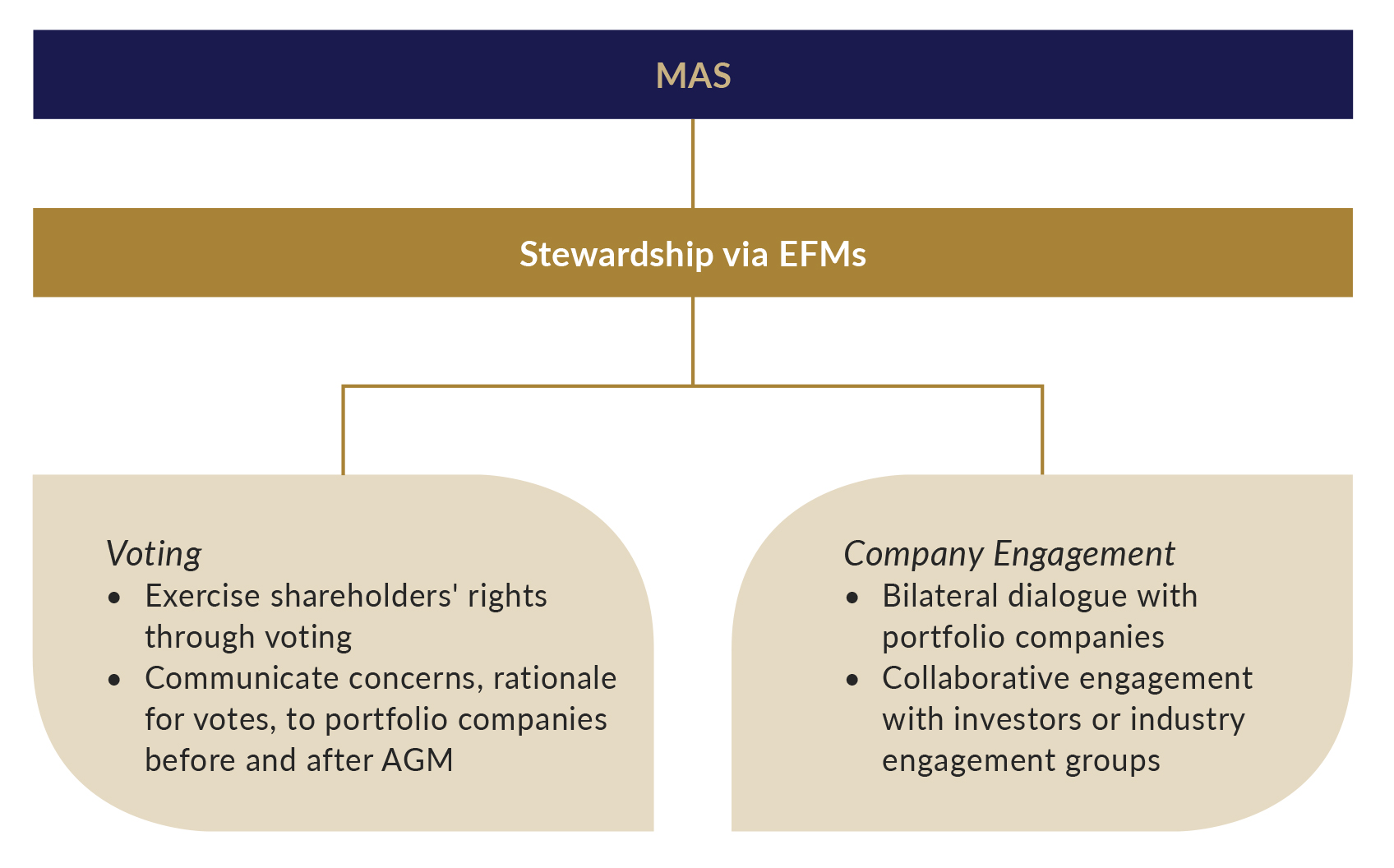
To ensure that our EFMs act as proper stewards of companies which we have invested in, they must abide by the following stewardship principles:
- Materiality. Greater focus should be placed on sustainability risks that pose material investment risk.
- Progress. Continuous improvement should be made, in line with evolving industry standards.
- Accountability. Stewardship activity must be measured and reported.
- Cooperation. Engage early and engage actively. Divest only as a last resort.
Stemming from these core principles, we expect our EFMs to:
- Establish internal frameworks and policies, for example, setting out ESG principles and priorities, establishing policies to integrate ESG considerations in their investment process and determine materiality of companies to engage, and developing a clear, robust escalation framework.
- Vote responsibly and have constructive and purposeful engagements with portfolio companies on material issues, and support them in improving their ESG practices and make progress towards meeting their commitments and targets. Collaborating with like-minded investors via collective engagement platforms can allow for a stronger voice in engaging companies.
- Monitor results on key engagement deliverables and milestones, and assess implications for subsequent engagements and voting on shareholder resolutions.
- Disclose stewardship activities and outcomes periodically.
Specifically on climate change, we expect our EFMs to:
- Integrate climate change considerations into policies and strategy. EFMs should set short-term and long-term emissions targets for portfolios in a manner that is consistent with the Paris Agreement. EFMs should implement strong governance frameworks to ensure that their management teams are accountable for climate risk and describe how such risk are managed. Additionally, EFMs should set out a clear escalation framework that lays out their approach toward portfolio companies that are less responsive to engagement, with divestment as a possible last resort.
- Integrate material climate change risks into risk management. EFMs should identify climate risk and consider relevant adaptation and mitigation measures. The analysis should extend to the supply chains of portfolio companies. Moreover, EFMs should encourage portfolio companies to implement relevant procurement policies, engage with strategic suppliers and integrate the cost of carbon into how they manage their supply chains.
- Disclose material climate change information. In alignment with Task Force on Climate-related Financial Disclosures (TCFD) recommendations, EFMs should encourage portfolio companies to disclose the greenhouse gas emissions associated with their business operations and value chains, with such emissions being estimated in accordance with the Greenhouse Gas Protocol or other relevant industry or national standards.
We assess our EFMs’ ESG engagement and voting efforts on a regular basis. This assessment will inform the extent of our subsequent engagements with them.
Stewardship case studies on climate change topics
A. Engagement on carbon reduction plans
- One of our EFMs is an investor in an American multinational corporation in the oil and gas industry.
- The EFM had a long history of multi-year, comprehensive engagements with the company on a wide range of governance issues that the EFM believes to drive long-term shareholder value. These include board composition and independence from management, corporate strategy, and the oversight of climate risk.
- The EFM emphasised in a vote bulletin explaining its vote in the 2020 annual meeting that the risks of climate change and the transition to a lower carbon economy present material regulatory, reputational, and legal risks that may significantly impair companies’ financial position and ability to remain competitive going forward. The EFM called for the company and its board to further assess business strategy and board expertise, taking into account potential net-zero transition scenarios.
- In response to feedback from the EFM and other like-minded shareholders, the company took steps to enhance its climate commitments and disclosures. These included updating its emissions reduction targets to include methane, committing to disclose scope 3 emissions in 2021, creating a new business segment to advance carbon capture and storage opportunities globally, and including the adoption of low emissions technologies into its broader corporate strategy. In January 2022, the company announced its ambition to achieve net-zero greenhouse gas emissions for operating assets by 2050, backed by a detailed roadmap for major facilities and assets.
B. Collaborative engagement on decarbonisation and disclosure
- An electric utility company in Asia traditionally relying on coal- and gas-fired power plants was selected as a focus company for the Asian Investor Group on Climate Change (AIGCC) Asian Utilities Engagement Program (AUEP). Under this programme, one of our EFMs, along with its peers, has been encouraging large Asian utilities to reduce emissions, strengthen disclosure and improve governance of climate-relate related risks.
- Last year, the group met with the company to better understand and provide feedback on its transition plans and targets. The company has since published a climate-related disclosure report announcing medium- and long-term decarbonisation commitments including setting emission intensity targets, phasing out its coal-based assets and achieving net-zero emissions. In addition, the company will invest more in clean energy, back renewable energy development and pursue further opportunities in transition enablers, such as hydrogen blending.
C. Voting on energy transition and decarbonisation
- One of our EFMs is invested in a wind power company which primarily designs, develops and operates wind farms. Recently, the company has expanded its focus to include new energy, including projects in solar, biomass, tidal, geothermal and thermal power generation.
- As an active long-term investor, the EFM engages with the company on sustainability-related issues to help create value for shareholders. When the EFM first invested in the company, it was still partially dependent on coal-fired power plants to generate its energy. In view of potential growth opportunities within the renewables market, the EFM had voted in favour of a proposal to restructure the company’s portfolio to eliminate all coal-fired power businesses and increase renewable energy projects. The company is currently in the midst of doing so, and the EFM believes this will reduce the company’s carbon risk while also creating a stronger growth pipeline.
Our portfolio actions therefore seek to manage transition risks in the equities portfolio in different ways, given the current nascent developments around corporate disclosures, taxonomies, standards, methodologies and also regulations.
Employing a wider range of portfolio actions would allow MAS to influence real world emissions reduction of companies in the portfolio through our fund managers, invest more actively in transition opportunities and climate solutions, maintain flexibility to effectively reduce portfolio emissions and transition risk exposures when needed and, as a last resort, avoid investing in selected companies altogether.
The actions we take will grow and evolve over time with better data and techniques and as the imminence and clarity about physical and transition risks increase.