Strategy
Overview
The financial sector plays a critical role in the net zero transition. MAS has supported the development of the sustainable finance ecosystem, comprising financial institutions, ancillary service providers, academia, standard setting bodies and international organisations in Singapore. These stakeholders catalyse the co-creation of innovative financing solutions, raise capabilities and skills, and enhance corporates’ adoption of sustainability practices.
Over the past year, MAS has taken concerted actions to lay out its commitment and develop strategies to catalyse the region’s transition to net zero.
- In September 2022, MAS launched the Financial Services Industry Transformation Map ("ITM") 2025, with sustainability being one of the key pillars. This signals MAS' commitment to catalyse the region’s transition towards net zero, where MAS will provide greater clarity on transition through the development of the Singapore-Asia Taxonomy and set supervisory expectations to steer financial transition planning process, facilitate the decarbonisation of real economy sectors through financing, and enhance sustainability disclosures and build data utilities.
- In April 2023, MAS launched the Finance for Net Zero ("FiNZ") Action Plan, which sets out MAS’ strategies to mobilise financing to catalyse Asia’s net zero transition and decarbonisation activities in Singapore and the region. It expands on the scope of MAS’ Green Finance Action Plan launched in 2019 to include transition finance. The FiNZ Action Plan aims to achieve four strategic outcomes: (i) Strengthen Data, Definitions & Disclosures; (ii) Foster a Climate Resilient Financial Sector; (iii) Support the adoption of financial institutions’ credible transition plans; and (iv) Promote Green & Transition Solutions & Markets. The four strategic outcomes will be enabled by Green FinTech Solutions and a skilled and capable workforce.
To effectively implement these strategies, close partnership with the industry is needed. The following sections outline the key initiatives undertaken in the past year, in support of MAS' ITM 2025 and FiNZ Action Plan.
- MAS media release, published on 20 April 2023, on the MAS launch of the Finance for Net Zero Action Plan
- Speech by Deputy Prime Minister and Minister for Finance, and Deputy Chairman of the MAS, Mr Lawrence Wong, delivered on 20 April 2023, at the launch of the Sustainable and Green Finance Institute (SGFIN)
- MAS media release, published on 15 September 2022, on the MAS launch of the Financial Services Industry Transformation Map 2025
- Speech by Deputy Prime Minister and Minister for Finance, and Deputy Chairman of the MAS, Mr Lawrence Wong, delivered on 15 September 2022, at the launch of the Financial Services Industry Transformation Map 2025
Accelerate Transition Finance through Solutions and Markets
Blended Finance
According to McKinsey Global Institute, global annual investment required to reach net zero is US$9.2 trillion, with more than one third (US$3.1 trillion) required in the Asia Pacific. However, much of this investment is not bankable today. By balancing investment risks and returns through the deployment of concessional capital, blended finance can boost return profiles or de-risk projects. Blended finance synergises public and private capital to mobilise financing for projects that are marginally bankable, and has the potential to unlock ~40% of the net zero capital needs.
Singapore has embarked on a number of key initiatives to scale transition and blended finance.
- Infrastructure Asia, launched by MAS and Enterprise Singapore, provides expertise in project scoping and sharing of best practices in project development, and facilitates infrastructure financing deals in the region.
- Clifford Capital, whose borrowings are guaranteed by the Singapore Government, provides debt financing to crowd in private sector participation for infrastructure projects.
- Bayfront Infrastructure Management, which similarly enjoys a lower borrowing cost from a Singapore Government guarantee, acquires and repackages project finance loans and bonds into infrastructure asset backed securities for investments by international institutional investors, and thereby recycles bank capital for additional project financing.
- Pentagreen Capital, a partnership between HSBC and Temasek Holdings, will deploy blended finance at scale to unlock marginally bankable projects in Southeast Asia.
MAS sees opportunities to scale blended finance and crowd in capital from non-traditional sources, including philanthropic capital. Philanthropic capital is patient, risk tolerant, and flexible in terms of repayment and risk absorption capacity. This is especially useful in the case of climate-related technologies and innovations, which require significant upfront investments and have long payback periods, making them riskier and less attractive to commercial investors who need market rate returns.
In June 2023, the S$5 million Asia Climate Solutions ("ACS") Design Grant hosted by Convergence, received funding commitments from MAS, the Olayan Group, UBS Optimus Foundation, and the Australian Department of Trade and Foreign Affairs, and launched its call for proposals. The grant scheme provides funding for feasibility studies and proof of concept work on innovative blended finance solutions in target sectors that are significantly under-capitalised in Asia, such as early-stage climate adaptation and mitigation technology, clean energy access, sustainable transport, and nature-based solutions. MAS will continue to coalesce greater participation from philanthropic players in the ACS Design Grant and the broader climate agenda.
Green, Social, Sustainable, Sustainability-Linked and Transition Bonds and Loans
Singapore is ASEAN’s largest market for green, social, sustainability and sustainability-linked (“GSSSL”) bonds and loans, accounting for more than half of the market. MAS supports global and Asian corporates to access sustainable financing for green and transition projects through the Sustainable Bond Grant Scheme and the Sustainable Loan Grant Scheme.
Notwithstanding the broader global slowdown in bond and loan issuances due to rising interest rates and inflation risks in 2022, total issuance of GSSSL bonds and loans have remained resilient in Singapore.
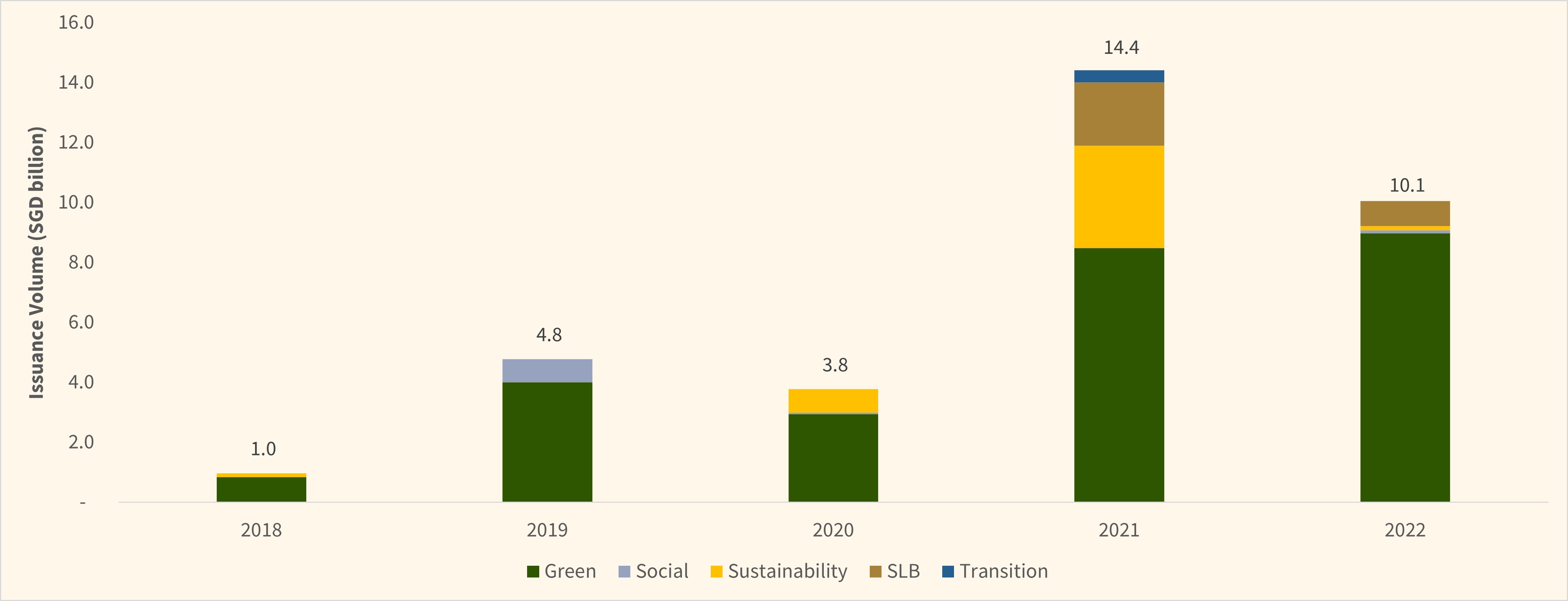
- GSSSL bond volumes in 2021 and 2022 reached S$24.5 billion, an increase of more than 2.5 times of the S$9.6 billion achieved in 2018 to 2020 (see Chart 1).
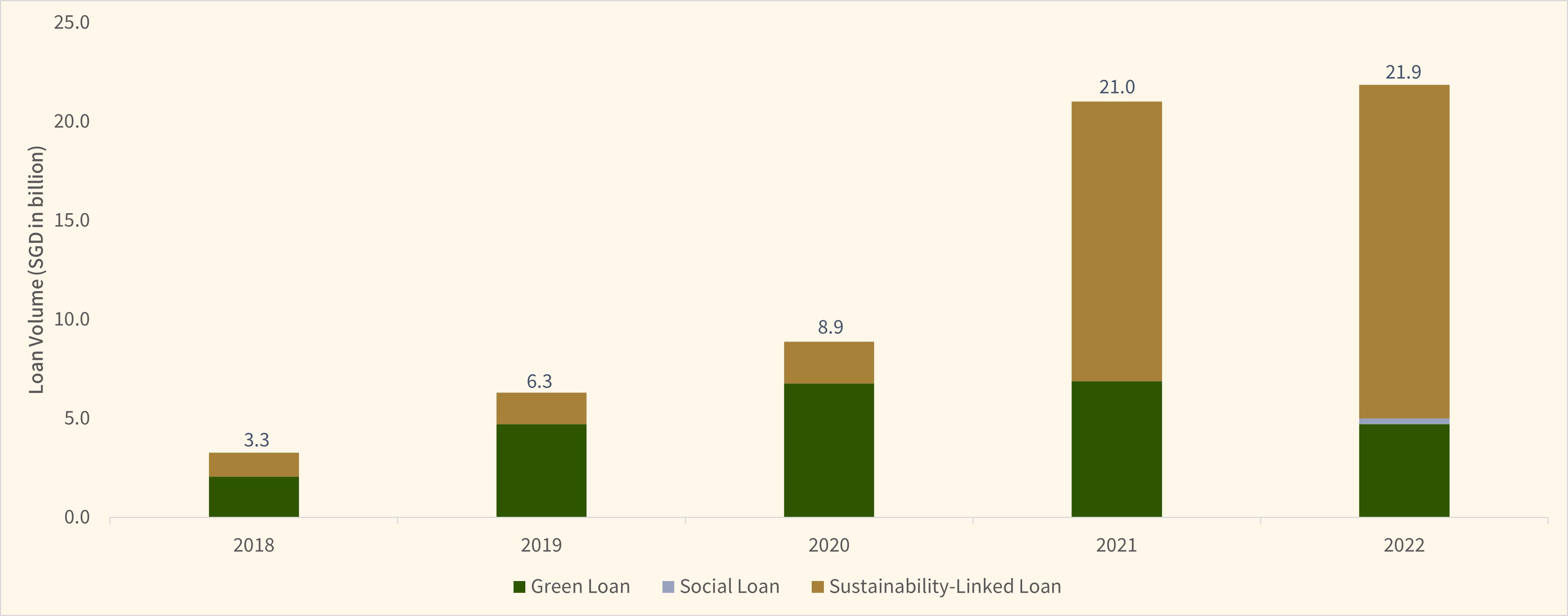
- The volume of GSSSL loans originated from Singapore in 2022 hit a yearly high for the fifth consecutive year with over S$20 billion loans issued (see Chart 2).
- The issuance of sustainability-linked instruments slowed in 2022 due to greater awareness and market focus over the rigour of sustainability targets and greenwashing risks.
Transition bonds and loans are a relatively new asset class. These transition instruments are focused on supporting “brown” companies to become green and can have a greater impact on climate transition than issuing pure green bonds and loans alone. Pure green activities such as green technologies and renewables make up less than 8% of the global economy. Non green transition activities, make up the remainder 92%. There is an emerging consensus that it is not just investment in green activities that is needed, but also in transition activities. This means channelling financing to transform and decarbonise sectors including manufacturing, building and construction, aviation, maritime, agriculture and fisheries. Yet, transition bonds today form a very small segment – less than half a percent – of the global sustainable bond market, largely due to lack of clarity in definitions around transition activities.
In April 2023, MAS expanded the Sustainable Bond and Loan Grant Schemes to include transition bonds and loans subject to necessary safeguards, and set aside S$15 million over the next five years till end 2028 for the enhanced grant schemes. To promote greater transparency in the sustainable debt market, MAS’ enhanced Sustainable Bond Grant Scheme and Sustainable Loan Grant Scheme will provide a higher grant cap of S$125,000 (up from S$100,000) to incentivise issuers' and borrowers' early adoption of entity-level sustainability disclosures that are aligned with international disclosure frameworks and standards.
Chart 1: Green, Social, Sustainability, Sustainability-linked and Transition Bond Issuance Volume in Singapore (2018 to 2022)
Source: MAS' estimates
Chart 2: Green, Social, and Sustainability-linked Loan Issuance Volume in Singapore (2018 to 2022)
Source: Environmental Finance database, based on country of borrower headquarters
Insurance-Linked Securities
MAS has been developing Singapore as a centre for climate risk financing instruments, including catastrophe bonds. These enable the insurance industry to raise additional financing for protection against disaster risks.
MAS’ Insurance Linked Securities ("ILS") Grant Scheme was launched in December 2018 and has supported the issuance of 23 catastrophe bonds in Singapore. Catastrophe bond issuances in Singapore totalled S$2.5 billion over 2021 and 2022, more than twice the total of S$1.2 billion from 2018 to 2020. These included landmark transactions that enhanced protection capacity in Asia, specifically:
- International Bank for Reconstruction and Development ("IBRD"): The first Asian sovereign catastrophe bond covering earthquake and typhoon risks in the Philippines, which was also the first catastrophe bond listed on the Singapore Exchange; and
- Akibare Re Pte Ltd: The first Asian catastrophe bond covering typhoon and flood risks in Japan.
In April 2023, MAS announced the extension of the scheme for an additional two years, until 31 December 2025, and the expansion of its coverage beyond bonds, to include reinsurance sidecars and collateralised reinsurance arrangements. This will contribute to growing a vibrant ILS ecosystem in Singapore to service Asian risks and clients.
- MAS media release, published on 20 April 2023, on MAS launch of Finance for Net Zero Action Plan
- Speech by Deputy Prime Minister and Minister for Finance, and Deputy Chairman of the MAS, Mr Lawrence Wong, delivered on 20 April 2023, at the launch of the Sustainable and Green Finance Institute (SGFIN)
- MAS media release, published on 4 October 2022, on Public-Private Partnerships to Mobilise Capital for Net Zero Transition
- Speech by MAS Managing Director, Mr Ravi Menon, delivered on 4 October 2022, at the Transition Finance towards Net Zero Conference
Promote Greater Clarity on Definitions, Particularly to Strengthen the Credibility of Managed Phaseout of Coal
Singapore-Asia Taxonomy
To unlock sustainable finance, we need common definitions for activities that contribute to climate goals. Taxonomies are a key tool for unlocking green and sustainable finance. By providing clarity to the market on what activities can be considered green or sustainable, taxonomies can facilitate the scaling up of green finance.
The Green Finance Industry Taskforce ("GFIT"), convened by MAS has carried out three phases of taxonomy consultations in January 2021, May 2022 and February 2023 respectively. The February 2023 consultation proposed detailed thresholds and criteria for five additional sectors: (i) agriculture and forestry/land use; (ii) industrial; (iii) waste and water; (iv) information and communications technology; and (v) carbon capture and sequestration.
In June 2023, MAS launched a public consultation on the detailed thresholds and criteria for financing the early phase-out of coal-fired power plants under the Singapore-Asia Taxonomy. This aims to provide a credible, science-based standard to increase the usability of coal transition financing vehicles that are aligned with the 1.5 degrees Celsius transition pathway. The criteria includes both facility and entity level criteria - a coal-fired power plant can be considered aligned with the guidance and potentially suitable for a managed coal phaseout process if it meets all the facility level and entity level criteria.
Energy transition mechanisms have gained momentum in key coal markets, ranging from securitisation transactions in the United States to comprehensive coal transition packages such as the Just Energy Transition Partnerships being discussed and implemented in, inter alia, South Africa, Indonesia and Vietnam. However, these mechanisms are still in the early stages of design, and acceptance by financial institutions, countries, and other stakeholders has yet to be established. There is therefore a need for clear guidance on the credible use of climate finance to support the coal transition in the power sector to build confidence in and enable the scaling of these tools.
Providing specific, universal criteria and thresholds associated with Paris-aligned coal transition activities help governments, financial institutions and corporates, so that they need not go through the process of independently defining the credibility of each transaction. Financial institutions often do not have the right expertise at hand or the effect of scale and thus have to engage in a time-and-resource consuming process that is open for interpretation and prone to greenwashing.
- MAS media release, published on 28 June 2023, on MAS Launches Consultation on Coal Phase-Out Criteria under the Singapore-Asia Taxonomy
- Speech by Ms Indranee Rajah, Minister in the Prime Minister's Office, Second Minister for Finance and National Development, delivered on 28 June 2023, at the ICMA 9th Annual Conference of the Principles
- MAS media release, published on 15 February 2023, on launch of Third Consultation on Green and Transition Taxonomy
- MAS media release, published on 12 May 2022, on launch of Second Consultation on Green and Transition Taxonomy
- MAS media release, published on 28 January 2021, on launch of First Consultation on Green and Transition Taxonomy
Foster Transition-Ready Talent and Workforce
Anchor Sustainable Finance Organisations, Centres of Excellence and Training & Research Institutes
Since 2020, MAS has anchored three Centre of Excellences ("CoEs") in Singapore – (i) Singapore Green Finance Centre ("SGFC"); (ii) Sustainable Finance Institute of Asia ("SFIA"); and (iii) Sustainable and Green Finance Centre ("SGFin"). The three CoEs set out distinct value propositions, with the respective research areas complementing each other.
- SGFC is working to design courses around the 12 Institute of Banking and Finance ("IBF") Sustainable Finance Technical Skills and Competencies ("SF TSCs"). A course on "Climate Change Management" has been launched which intends to synthesise information on climate change and climate policy developments to shape an organisation's strategies and policies, products and/or services. More courses will be rolled out in 2023.
- SGFin was launched officially on 20 April 2023. In collaboration with the NUS Business School, SGFin offers a Master of Science programme in Sustainable and Green Finance (MSc SGF). The programme supplements foundation and core modules in finance with elective modules on measuring environmental impacts of various industries and how measures can be utilised for policy making and strategic business and corporate decisions.
To complement our CoEs which provide broad-based training and research, there is a need to look towards establishing specialised institutes with in-depth expertise to build knowledge and capabilities in specific domains such as carbon markets, impact investing and carbon markets. For example, the International Emissions Trading Association ("IETA") has set up its Asia Hub in Singapore in June 2023, to support carbon initiatives in the region. Over the past year, MAS has anchored institutes to provide specialised training and research.
- In 2022, the Centre for Sustainable Finance and Private Wealth ("CSP"), founded at the University of Zurich, supported the set-up of an office in Singapore. CSP Singapore provides specialised training backed by applied research in sustainable finance, tailored for the wealth management industry in Asia, and including areas such as impact investing and blended finance.
- In 2023, Convergence, the global network for blended finance, launched their Asia Pacific office in Singapore. The office supports their focus to drive the use of blended finance and deepen capabilities in Asia. This office also facilitates the development of more blended finance initiatives dedicated to support the region’s transition needs.
Since the formation of the Glasgow Financial Alliance for Net Zero ("GFANZ") Asia Pacific ("APAC") Network Central Office in Singapore in June 2022, it has served as the coordination bridge between GFANZ and sub-sector alliances' work and financial ecosystems in APAC, and anchored technical climate transition related discussions, knowledge, research, capacity building and related initiatives. MAS Managing Director Mr Ravi Menon chairs the GFANZ APAC Network’s Advisory Board. In June 2023, it launched a public consultation on its proposed set of voluntary guidance for financing the early retirement of coal-fired power plants in Asia, as part of a just net-zero transition.
Deepen Sustainable Finance Skills and Capabilities
MAS will continue work to invest in the skills and capabilities of our people and organisation, including reskilling and upskilling of these in the existing workforce. Over the past year, the IBF has trained 1,750 participants through more than 80 sustainable finance courses, including those accredited under the 12 SF TSCs under the Skills Framework for Financial Services.
In October 2022, the Private Banking Industry Group ("PBIG") Sustainability Taskforce, in consultation with the IBF and the MAS, developed a common industry training benchmark to upskill private banking relationship managers in the area of sustainability, taking reference from the 12 SF TSCs developed by IBF and MAS.
MAS, in partnership with IBF, has also commenced the Jobs Transformation Map ("JTM") for Sustainable Finance in 2023. The JTM study aims to quantify the number and type of sustainable finance jobs that will be created in Singapore in the next 3, 5 and 10 years, referencing expected changes to financial sector roles. It will assess the skills required for individuals to perform the sustainable finance roles identified, identify skill gaps in the current workforce, and provide relevant recommendations to plug these gaps. The JTM study is overseen by a Steering Committee comprising representatives from MAS, Singapore Exchange and various industry associations, including those from the banking, asset management and insurance sectors.
- Grow Sustainable Finance Expertise, MAS Sustainability Report 2021/2022
- ABS media release, published on 14 October 2022, on Singapore private banking industry taking the lead in setting training benchmark in sustainable finance
- MAS media release, published on 9 February 2022, on launch of 12 Technical Skills and Competencies in Sustainable Finance by IBF and MAS
Harness Technology and Green Fintech
Scale Sustainability Disclosures
Last year, MAS launched the Greenprint Disclosure Portal, titled ESGenome, with Singapore Exchange ("SGX") as a pilot for listed companies’ sustainability disclosure purposes. Since then, over 180 SGX-listed companies have been onboarded onto ESGenome, with over 40% of them starting to populate their data. On average, these listed companies have filled in 60 ESG metrics, with some populating up to 300 metrics.
Moving forward, MAS will be working with SGX, Accounting and Corporate Regulatory Authority ("ACRA") and Enterprise Singapore to support disclosures by Small and Medium-sized Enterprises (SMEs). This includes scaling ESGenome into a disclosure utility capable of meeting national-level reporting needs, including reporting by SMEs and private companies, defining baseline metrics to streamline SME reporting, and coordinating SME training initiatives to encourage adoption.
MAS and the Association of Banks in Singapore ("ABS") have embarked on a proof-of-concept for SMEs to undertake basic sustainability reporting through ESGenome. Learnings from the proof-of-concept will support the scaling of ESGenome into a national utility capable of meeting the reporting needs beyond the listed companies, for all corporates.
Bridge Global Interoperability of Sustainability Data and Platforms
In June 2023, MAS, SGX and the Net Zero Data Public Utility ("NZDPU") signed a Memorandum of Understanding to establish interoperability between Greenprint and the NZDPU to support the consent-based flow of reporting entities’ Scope 1, 2 and 3 emissions data, net zero targets, and carbon offsets usage, in order to work towards a joint vision of transparent and comparable net zero data.
MAS is also partnering the United Nations Development Program ("UNDP") and the Global Legal Entity Identifier Foundation ("GLEIF") to develop global digital Environmental, Social and Governance ("ESG") credentials for SMEs, leveraging Greenprint to support the reporting, verification and generation of these credentials. Titled “Project Savannah”, the collaboration was teed off at the Inclusive Fintech Forum held in Kigali, Rwanda in June 2023, and aims to coalesce in a multi-jurisdictional pilot to be launched at COP28 in Dubai.
- MAS media release, published on 27 June 2023, on MAS and SGX Group to collaborate with the Climate Data Steering Committee to strengthen global access to climate transition-related data
- MAS media release, published on 22 June 2023, on UNDP, GLEIF and MAS to embark on Project Savannah to digitise basic ESG Credentials for MSMEs
Strengthen Industry and International Partnerships
Given the scale of investment needed to get to net zero, governments will not be able to do this alone. There is an urgent need for public, private, and philanthropic stakeholders to work more synergistically together at regional and global levels, to mobilise larger amounts of climate finance.
Singapore Sustainable Finance Association
The Green Finance Industry Taskforce ("GFIT") was convened by MAS in 2019, comprising representatives from financial institutions, corporates, non-governmental organisations and financial industry associations. The Taskforce accelerated the development of sustainable finance through four key initiatives: (i) develop a taxonomy; (ii) improve disclosures; (iii) foster green finance solutions; and (iv) enhance environmental risk management practices of financial institutions. The Taskforce also supported sustainable finance capability building among banks, insurers and asset managers.
With the conclusion of GFIT’s work in April 2023, MAS announced in June 2023 plans to establish a new Singapore Sustainable Finance Association ("SSFA") to drive transition finance in Asia. The SSFA, which will be initially co-chaired by representatives from BlackRock and HSBC Singapore, will include members and partners from financial institutions, exchanges, financial industry associations, and relevant corporates and service providers such as ESG rating agencies. It builds on the extensive work completed by the GFIT and seeks to synergise across the ecosystem to develop sustainable finance solutions and capabilities in Singapore. The Association of Banks in Singapore ("ABS") is leading the coordination and setting up of the SSFA.
Industry Engagement Conference and Roundtables
To strengthen thought leadership, raise awareness, and facilitate sharing and collaboration across the financial sector and real economy, MAS is convening platforms designed to mobilise financing required for an effective and inclusive transition to net zero through the development of practical financing solutions and concrete projects:
- Transition Finance towards Net Zero ("TFNZ") Conference. In October 2022, MAS, together with knowledge partners McKinsey & Company and Convergence, and supported by the Glasgow Financial Alliance for Net Zero ("GFANZ"), hosted the inaugural TFNZ Conference. Themed “Scaling Blended Finance”, the conference was attended by more than 500 leaders and distinguished guests globally from international financial institutions, private and sovereign wealth funds, family offices, philanthropy foundations, development agencies, government representatives, and other players from the blended finance ecosystem. It covered the challenges and opportunities in scaling blended finance, enablers for a successful public-private partnership, as well as discussed use cases of how blended finance can be applied at scale, including in highly complex areas such as nature-based solutions and the energy transition. The conference also featured the launch of a S$5 million Asia Climate Solutions Design Grant and an initiative by the GFANZ Asia-Pacific ("APAC") Network to develop guidance for financial institutions on how they can facilitate the managed phase-out of coal power generation in Asia.
- Financing Asia’s Transition ("FAST") Conference. Jointly organised by MAS, BlackRock and Temasek, the FAST Conference in June 2023 saw the coming together of key decision-makers across financial institutions and the real economy to catalyse both green and transition finance. The conference covered topics such as opportunities in climate financing particularly in emerging markets and developing economies, building net zero portfolios, developing a trusted global carbon market, phasing out Asia’s coal-fired power plants and leveraging philanthropic capital. At the conference, MAS announced that it will set supervisory expectations to steer financial institutions’ transition planning processes to facilitate credible decarbonisation efforts by their clients, and work with other government agencies to explore platforms to channel blended finance at scale into green and transition infrastructure projects in the region. MAS also announced the establishment of the SSFA.
- FiNZ Connect. To facilitate more in-depth exploration of complex topics and solutioning, and enable more opportunities for collaboration across the industry, MAS is working with knowledge partners to host a series of FiNZ Connect roundtables and workshops. The FiNZ Connect series complement the conferences and enable greater opportunities for collaboration across the ecosystem. Roundtables held in 2023 included discussions on strategies to achieve Singapore’s 2050 net zero goal, decarbonisation of the maritime sector, managed phaseout of coal, and the role of insurers and philanthropies in scaling blended finance to mobilise capital for the transition.
Network of Central Banks and Supervisors for Greening the Financial System Singapore Meetings - Annual Plenary Meeting, Asia and Pacific Outreach Session, NGFS Workshop
MAS hosted a series of meetings on 25 and 26 April 2023 for the Network of Central Banks and Supervisors for Greening the Financial System ("NGFS"). The meetings discussed issues related to the assessment and management of climate-related financial risks and transition financing for a more sustainable economy. The NGFS is currently chaired by MAS Managing Director Mr Ravi Menon.
- The NGFS Annual Plenary Meeting brought together physically and virtually its 144 member institutions and observers to discuss the progress of its workplan in the past year and upcoming deliverables, including the role of supervisors on transition planning by financial institutions and training and capacity building.
- The NGFS Plenary Outreach with Asia-Pacific members discussed identifying and managing climate related financial risks in the region and facilitating financing flows to support Asia’s transition.
- The NGFS also held a full-day Workshop for more than 160 participants to discuss how central banks and supervisors could further support the work in areas on blended finance, macroeconomics of climate change, nature-related risks and transition planning.
NGFS Handbook on Scaling up Blended Finance for Climate Adaptation and Mitigation in Emerging Market and Developing Economies
The NGFS Blended Finance Initiative ("BFI") was launched at COP27 in November 2022. The BFI, which is co-led by MAS and the De Nederlandsche Bank ("DNB"), aims to use the convening power of the NGFS to raise awareness of climate blended finance among central banks and supervisors, and identify potential market, policy or regulatory barriers which hamper the scaling up of blended finance.
This blended finance initiative complements the NGFS’ core work of supporting its members in assessing the macroeconomic and financial stability implications of climate change and adjusting their policy actions accordingly. The NGFS aims to publish the Blended Finance Handbook by COP28, along with a showcase of demonstrative blended finance projects that have incorporated effective mechanisms to promote the scaling of blended finance.
- Collaborate Actively with Other Supervisors and Central Banks, MAS Sustainability Report 2021/2022
- Speech by Managing Director, MAS, and Chair, Network for Greening the Financial System, Mr Ravi Menon, delivered on 31 May 2023, on A Supervisory Push for Transition Planning and Blended Finance
- Speech by Managing Director, MAS, and Chair, Network for Greening the Financial System, Mr Ravi Menon, delivered on 9 November 2022, on How Central Banks and Supervisors are Helping to Green the Financial System
Collaboration with UK, China and Australia
At the 7th UK-Singapore Financial Dialogue on 25 November 2022, the UK and Singapore agreed on the need to mobilise capital to finance the transition to net zero in developing economies, using innovative approaches such as blended finance and carbon markets. The meeting discussed transition finance, disclosure standards, greenwashing, natural capital and biodiversity, and agreed to a roadmap for subsequent engagements in sustainable finance. An industry-led business roundtable on sustainable finance was held at the side of the Dialogue.
MAS and the People’s Bank of China have established the China-Singapore Green Finance Taskforce ("GFTF") to deepen bilateral cooperation and facilitate greater public-private sector collaboration in green and transition finance. The inaugural GFTF meeting, held in Chongqing in April 2023, discussed joint initiatives in three priority areas: (i) taxonomies and definitions; (ii) products; and (iii) technology. All three workstreams are aimed at scaling green and transition financing flows between China, Singapore, and the region.
Singapore and Australia signed the Singapore-Australia Green Economy Agreement ("GEA") on 18 October 2022, as part of the 7th Singapore-Australia Leaders’ Meeting in Canberra, Australia. The Singapore-Australia GEA outlines a set of green economy principles and the scope of cooperation in seven areas, including in green and transition finance. At the 8th Singapore-Australia Leaders’ Meeting in Singapore on 2 June 2023, it was announced that both Singapore and Australia will contribute funding towards the S$5 million Asia Climate Solutions ("ACS") Design Grant to facilitate more green and transition finance flows to the region. Other funding partners include The Olayan Group and UBS Optimus Foundation.